Sandro Botticelli · c.1485–1486
The Birth of Venus: what we know, and what we only think we know
Botticelli's Birth of Venus is a tempera-on-canvas mythological scene from Florence, and some of its best-known stories — the patron, the model — rest on tradition rather than documented fact.
Published 29 October 2026
| Artist | Sandro Botticelli |
|---|---|
| Painted | c.1485–1486 |
| Medium | Tempera on canvas |
| Size | 172.5 × 278.9 cm |
| Collection | Uffizi, Florence |
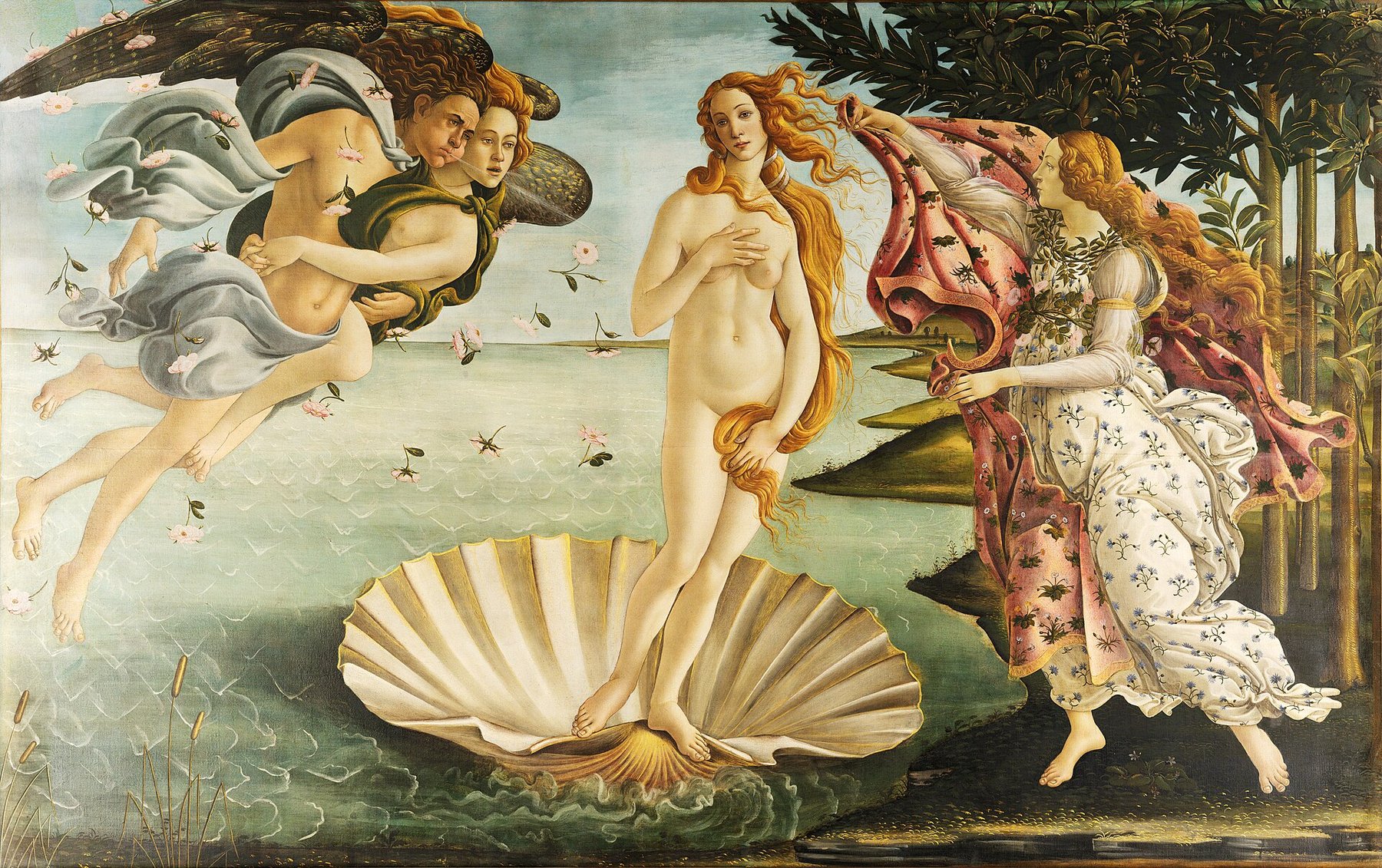
The Birth of Venus is big. Painted around 1485–1486 in tempera on canvas, it measures 172.5 × 278.9 cm and has been in the Uffizi in Florence for centuries. Venus stands on a shell at the centre, blown ashore by winged winds on one side and received by a flower-scattered figure on the other, in a painting that helped define how the Renaissance imagined classical myth.
Much of what circulates about the picture is later legend. The patron is debated, the identity of the model is unknown, and even the painting's earliest documented location dates from decades after its making. This article separates what is solid — the object, its composition, its technical peculiarities — from what is only tradition.
The object itself
The support is the first surprise: this is canvas, not panel. In Florence at that time most serious painting was done on wood panels, and large canvases were unusual, which has fed theories about where and how the picture was meant to be displayed — possibly in a villa, possibly hung differently from an altarpiece. The technique is tempera, applied in fine layers that keep edges crisp and colours pale and matte.
The subject comes from classical myth as filtered through Renaissance poetry: Venus, born of the sea, arriving at the shore. At the left, Zephyrus, the west wind, carries a female figure — identified in scholarship as Aura or as Chloris, with different arguments for each. At the right, one of the Hours steps forward with a flowering mantle. Roses fall through the air; orange trees line the grove behind.
Florence in the 1480s: the patron question
The painting was made in Florence during Botticelli's mature years, when his workshop worked for the Medici circle and their allies. The oldest firm evidence is Giorgio Vasari, who in 1550 described seeing the Birth of Venus, together with the Primavera, at the Medici villa of Castello outside the city. That tells us where the picture was a lifetime later; it does not prove it was made for Castello.
A common proposal connects the commission to Lorenzo di Pierfrancesco de' Medici, cousin of Lorenzo the Magnificent, partly through surviving family records of mythological paintings; other scholars keep the question open. Equally unproven is the claim that Venus was modelled on Simonetta Vespucci, a noblewoman famous in her day — she had died by the mid-1470s, before the likely date of the picture, and no document links her to it. The honest answer is that patron and model are both educated guesses.
How the composition works
Botticelli organises the picture as a shallow, almost relief-like stage. Venus drives the centre, her weight-shifted pose derived from classical statues of Venus pudica, hands covering in the antique manner; her body is drawn more by line than by modelling, which is why the anatomy reads slightly impossible and entirely elegant. The winds on the left fly in a tangle of drapery, and the Hour on the right opens the mantle in a slow counter-movement.
The drawing carries the emotion. Outlines are consistent and calligraphic, drapery behaves decoratively rather than physically, and the sea is reduced to small V-shaped ripples that keep the surface flat. Colour is deliberately limited — pale flesh, sea-green water, the cloak's strong reds and whites — so the figure reads from far away. It is one of the first monumental female nudes of the post-classical West, and its balance of line, ornament and restraint is why it still looks modern.
In the Uffizi, and in replica form
In the Uffizi the scale registers immediately: at nearly 1.73 metres tall and 2.79 metres wide, the painting fills a wall and keeps a viewing distance built into the room. The tempera surface stays matte and fine-grained, and age has muted a palette that reproductions often brighten past the original's chalky, restrained key.
For a hand-painted replica, this is a painting of line, and line is exactly what a trained hand can follow: the contour of the body, the drawing of the hair, the rhythm of drapery. The colour field is broad and flat, which suits oil on canvas at full size. What cannot be reproduced is the specific surface of a fifteenth-century tempera-on-canvas object, with its age and conservation history. A faithful replica gives you the image at true scale; the original's material presence stays in Florence.
If you want it on your wall
The Birth of Venus, hand-painted for your size
The same composition, painted in oil on cotton canvas by hand — from $189, in any proportional size, with six frame options and a numbered certificate of authenticity. It is a modern reproduction, not an antique, and the certificate says so; what it is not is a canvas print with a texture filter over it.
Free worldwide shipping, rolled in a rigid tube. Custom sizes and framing are quoted on the page.
Questions
Questions about The Birth of Venus
Sandro Botticelli painted it in Florence, with the usual dating around 1485 to 1486 based on style and documentary context. It was made in the middle of his most successful period, when his workshop served the Medici circle, and it entered written art history through Vasari, who saw it in 1550 at the Medici villa of Castello along with Botticelli's Primavera.
Nobody can say for certain. The painting was recorded in 1550 at the Medici villa of Castello, and many scholars connect its commission to Lorenzo di Pierfrancesco de' Medici, a cousin of Lorenzo the Magnificent, but direct documentation from the 1480s is lacking. The unusual choice of canvas rather than panel has also been read as a clue to a domestic or villa setting rather than a church.
Unknown. The popular claim that she was modelled on Simonetta Vespucci, a celebrated beauty of Medici Florence, is later tradition with no documentary support; she had died years before the painting's likely date, and Botticelli left no statement on the matter. Scholars generally treat the figure as an idealised construction, built from classical poses rather than a portrait of a named woman.
It measures 172.5 × 278.9 cm, painted in tempera on canvas. That makes it one of the largest mythological canvases of fifteenth-century Florence and far bigger than most visitors expect, particularly compared with Botticelli's panel paintings. The size supports the design: the figures are kept simple and linear, so the composition still reads clearly from across the room in the Uffizi gallery.
More masterpieces
Vincent van Gogh
Sunflowers
The Arles Sunflowers in London was painted in August 1888 to decorate the room Van Gogh had prepared for Gauguin, and its famous y
Caspar David Friedrich
Wanderer above the Sea of Fog
Friedrich's Wanderer above the Sea of Fog is not a view of one real mountain but a composed landscape, assembled from studies, and
Edvard Munch
The Scream
Munch's The Scream exists in four versions, two of which have been stolen and recovered, and the 1893 original in Oslo is smaller,
Want The Birth of Venus at your own size?
Tell us the wall and we will quote the canvas — hand-painted in oil, rolled and shipped free, with a numbered certificate.