Edvard Munch · 1893
The Scream: what Munch actually painted, and why it still unsettles
Munch's The Scream exists in four versions, two of which have been stolen and recovered, and the 1893 original in Oslo is smaller, stranger and more fragile than its fame suggests.
Published 29 October 2026
| Artist | Edvard Munch |
|---|---|
| Painted | 1893 |
| Medium | Oil, tempera and pastel on cardboard |
| Size | 91 × 73.5 cm |
| Collection | National Museum, Oslo |
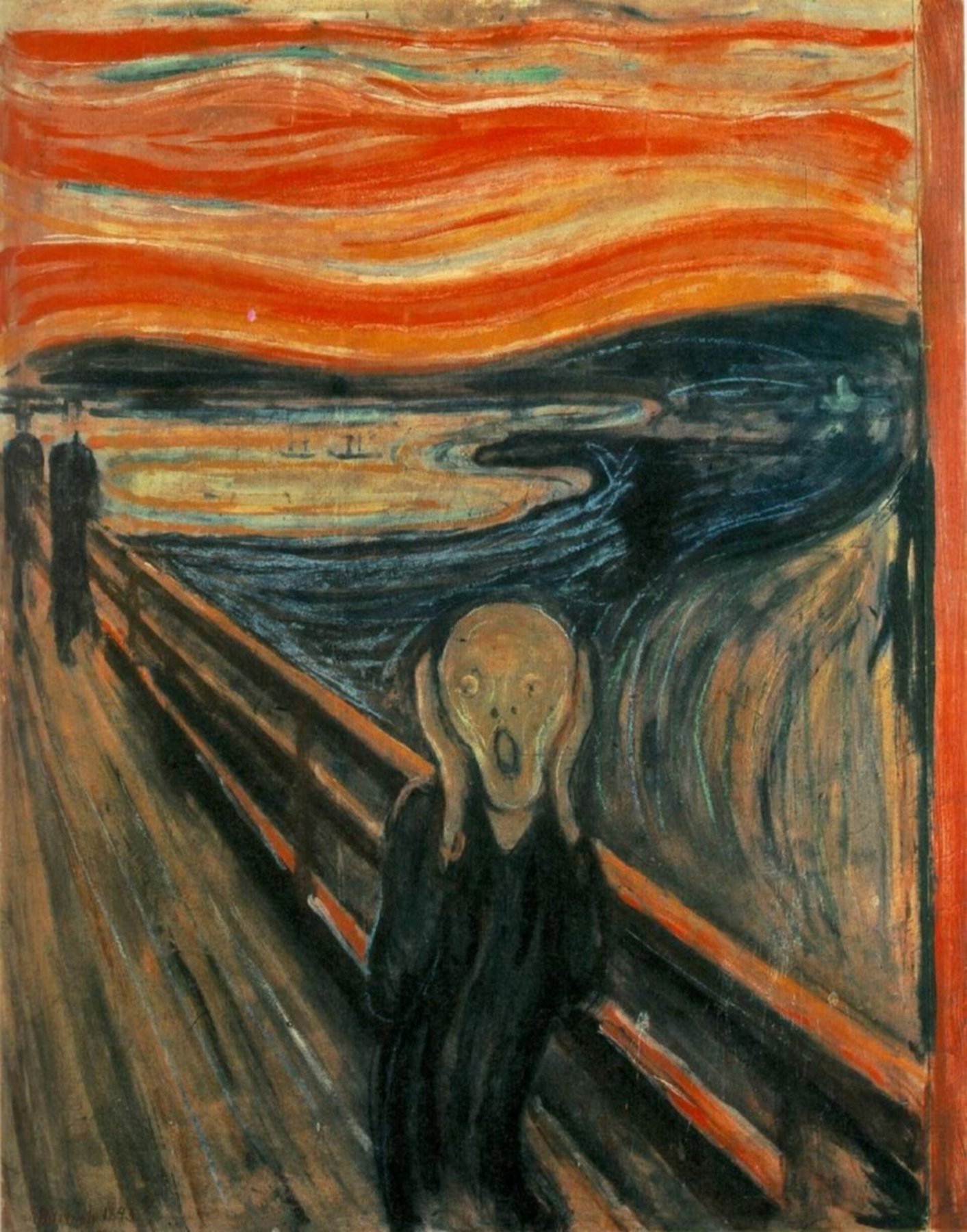
Most people meeting The Scream in person are surprised twice. First by the size: 91 × 73.5 cm is barely larger than a kitchen window, not the billboard icon of popular memory. Second by the surface: this is oil, tempera and pastel on cardboard, worked and reworked, and the mixture gives the image a matte, grainy quality no screen reproduces. The painted version of 1893 belongs to the National Museum in Oslo.
The fame has also flattened the facts. Munch made four versions of the image between 1893 and 1910, two in paint and two in pastel, and two of them were later stolen and recovered. This article goes through what the painting actually is, where it came from, how the composition works, and what a hand-painted replica can and cannot recover from it.
What the 1893 painting actually is
Between 1893 and 1910 Munch produced four versions of The Scream: two paintings and two pastels. The 1893 painted version, oil, tempera and pastel on cardboard, is the one now held by the National Museum in Oslo; the others are divided between the Munch Museum and private hands. No version is a mechanical copy of another. Munch adjusted colour, pressure and finish each time, which is why scholars treat the group as a sequence rather than as repetitions.
The 1994 theft took a version from Oslo's National Gallery, then the painting's home, and it was recovered within months. In 2004 armed thieves took another version, together with Munch's Madonna, from the Munch Museum; both were recovered in 2006, with damage that conservators later treated. The thefts belong to the object's history now, but they concern two versions out of four, not the whole series.
The circumstances: Munch in his early thirties
Edvard Munch was born in 1863 in Løten and grew up in Christiania, now Oslo, where his father worked as an army doctor. His mother and a beloved sister died of tuberculosis while he was young, and illness, death and anxiety became permanent subjects in his art rather than passing motifs. By his late twenties he was dividing his time between Norway, Paris and Berlin, and a scandal around his 1892 Berlin exhibition — his work was taken down within days — made his name across Germany.
The image itself came from a walk. In a written account set down years later, Munch described walking at sunset on a road above the Oslofjord with two friends, leaning against a railing, feeling ill and anxious, and sensing a vast, unending scream passing through nature. He recorded no quotation to hang on the picture; what survives is his own paraphrase of a moment around Ekeberg, above the fjord, that he kept returning to in sketches for years.
Why the image works: line, colour and a face
Compositionally the painting is built on one aggressive diagonal. The walkway cuts from the lower left towards the right edge, and its railing pulls the figure forward into our space. The figure stands slightly left of centre, mouth open, hands clamped to the head — and it reads ambiguously, as either crying out or trying to block out a sound. Two companions further back on the walkway continue along, apparently untouched, which isolates the figure completely.
The landscape answers the body. The fjord and sky are drawn in long, unbroken curves that repeat the outline of the figure's own contorted form, so that figure and environment seem to vibrate at the same frequency. Colour is banded: a red-orange stripe runs across sky and water against dark blues and greens below. Whether the red band records a sunset, blood or something purely psychological is undecidable, and Munch's own account places the scream in nature rather than in the mouth.
Seeing it today, and what a replica can give you
In Oslo the encounter is intimate. You stand close, the painting reads almost as a sketch by an enormous talent, and the detail worth noticing is the surface: dry, dragged strokes, pastel rubbed into painted ground, the cardboard faintly present. Reproductions tend to saturate the reds and smooth the transitions; the original's colours are stranger and more uneven, and the mood shifts under gallery light.
A hand-painted replica in oil on canvas can honestly recover the composition: the diagonal, the banded red and blue-green, the figure's gesture and the two indifferent walkers. What it cannot fully recover is the specific material history — cardboard, tempera and pastel in one object, plus the visible marks of Munch's reworking. What a good oil replica gives you is the image, at true size, in real pigment, made by hand.
If you want it on your wall
The Scream, hand-painted for your size
The same composition, painted in oil on cotton canvas by hand — from $189, in any proportional size, with six frame options and a numbered certificate of authenticity. It is a modern reproduction, not an antique, and the certificate says so; what it is not is a canvas print with a texture filter over it.
Free worldwide shipping, rolled in a rigid tube. Custom sizes and framing are quoted on the page.
Questions
Questions about The Scream
Four, made between 1893 and 1910: two painted versions and two in pastel. The 1893 painting in oil, tempera and pastel on cardboard is in the National Museum in Oslo, while the Munch Museum holds both a painted and a pastel version. One pastel version has remained in private hands, and it remains the most expensive Munch ever sold at auction.
Twice. In February 1994, during the Winter Olympics in Lillehammer, thieves climbed a ladder into the National Gallery in Oslo and took the painted version, leaving a note; it was recovered a few months later. In 2004 masked men robbed the Munch Museum by daylight and took another version along with Munch's Madonna; both paintings were recovered in 2006.
The painting deliberately supports both readings. The mouth is wide open, but the hands pressed over the ears suggest somebody shutting out a sound, and in the written account Munch gave years later, he described sensing a great, unending scream passing through nature while he stood on a road above the Oslofjord. In that telling, the figure reacts to the scream rather than producing it.
Several factors stack up. The gesture is legible in a second, the landscape is reduced to a few charged lines and bands, and the image arrived just as a century of urban anxiety was beginning. Munch's own later account attached a story to it, the Oslo museums kept the versions close together, and two thefts in 1994 and 2004 kept the painting in the news. Reproduction did the rest.
More masterpieces
Caspar David Friedrich
Wanderer above the Sea of Fog
Friedrich's Wanderer above the Sea of Fog is not a view of one real mountain but a composed landscape, assembled from studies, and
Vincent van Gogh
Café Terrace at Night
In September 1888 Van Gogh painted the Place du Forum in Arles at night using blues, greens and yellows, and told his sister he ha
Rembrandt van Rijn
The Night Watch
Rembrandt's Night Watch shows a militia company setting out in daylight; its famous name comes from darkened varnish, and a strip
Want The Scream at your own size?
Tell us the wall and we will quote the canvas — hand-painted in oil, rolled and shipped free, with a numbered certificate.