Caspar David Friedrich · c.1818
Wanderer above the Sea of Fog: how Friedrich built his most quoted image
Friedrich's Wanderer above the Sea of Fog is not a view of one real mountain but a composed landscape, assembled from studies, and its standing figure has never been definitively identified.
Published 29 October 2026
| Artist | Caspar David Friedrich |
|---|---|
| Painted | c.1818 |
| Medium | Oil on canvas |
| Size | 94.8 × 74.8 cm |
| Collection | Hamburger Kunsthalle, Hamburg |
The most reproduced painting of German Romanticism is a modest object. Wanderer above the Sea of Fog, dated around 1818, is an oil on canvas of 94.8 × 74.8 cm, and it has been in the Hamburger Kunsthalle in Hamburg since 1970. Visitors expecting a monumental canvas meet a vertical picture of middle size, dark at the edges and pale at the centre.
The painting's power comes from construction rather than observation, and from a figure we never see face on. This article covers what the canvas physically is, what Friedrich's position was around 1818, how the composition was assembled, and what separates the original in Hamburg from a well-made hand-painted replica. It is worth the effort: almost everything usually said about the picture — the date, the identity, the view — turns out to be qualified in some way, and the qualifications are where the interest lies.
What the painting is
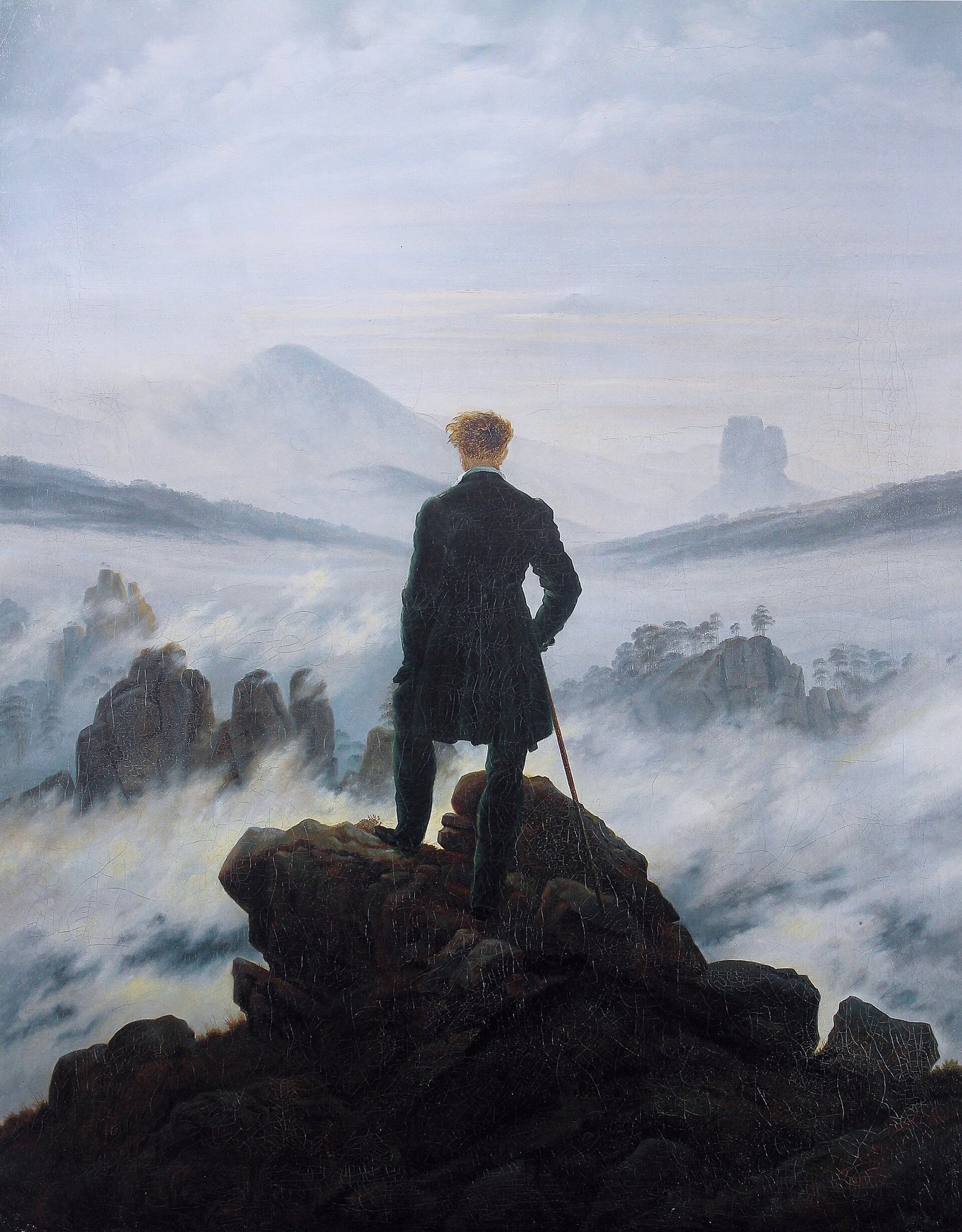
The canvas shows a man seen from behind, standing on a dark outcrop of rock, a cane in his right hand, looking out over a valley filled with fog. Ridges and peaks break the surface of the fog at intervals, and further mountains fade towards a pale sky. The figure occupies the middle of the picture, standing almost exactly where a viewer's eye would naturally enter the landscape.
It is not a record of one viewpoint. Researchers have matched individual rocks and ridges to studies Friedrich made on walking tours, particularly in the Elbe Sandstone Mountains of Saxony and Bohemia, and the picture combines them into a scene no single summit offers. The composition is a construction — accurate in its parts, invented as a whole.
Dresden around 1818: where Friedrich stood
Caspar David Friedrich was born in Greifswald on the Baltic in 1774 and settled in Dresden, where he built his career as a landscape painter inside the city's artistic circles. The years around 1815 to 1820 were his strongest professional period: he had shown at the Berlin academy, attracted the attention of royal buyers, and in 1818 he married Caroline Bommer.
The post-Napoleonic years also matter. The German-speaking lands had just emerged from French occupation, and Friedrich's landscapes, with their crosses, ruins and solitary waking figures, were read by some contemporaries as quiet statements of German feeling. Scholars still debate how deliberately political such pictures were. The wanderer fits that atmosphere — a lone figure above an obscured world — but who he is meant to be remains unsettled: suggested identifications include Friedrich himself and various contemporaries, and none is documented.
Why the composition works
The device at the centre is the Rückenfigur — a figure seen from behind, which Friedrich developed into a signature. It does three things at once. It blocks identification: you cannot read a face, so the figure stays a placeholder that anyone can occupy. It places you at his shoulder, sharing his viewpoint. And it scales the landscape: the peaks are kept small and layered, so height is felt through recession rather than exaggeration.
The tonal construction carries the rest. Dark rock frames the lower corners, the fog is a series of pale gradations rather than a flat white, and the horizon is kept high enough that the mist reads as a sea. The figure's verticality against those horizontal bands is the whole drama; nothing else in the picture moves. Friedrich's brushwork stays tight and even, letting value changes rather than gesture produce the depth. The picture depends on that stillness; put the figure in motion and it would collapse into ordinary scenery, which is exactly what hundreds of later imitations demonstrate.
Seeing the original, and what a replica can do
In Hamburg the painting is smaller and quieter than its internet life suggests, and the subtlety lives in the transitions — the way fog thins from grey to near-white, the thin dark line where a ridge meets mist. Photographic reproductions usually increase contrast and crispness; the original is softer, with the figure's coat and hair resolved in very few decisions.
For a hand-painted replica this is a rewarding picture and a demanding one. Oil paint handles the layered glazes of fog well, and the composition's clarity survives translation to canvas honestly. What a replica cannot supply is the original's surface at close range — the fine, controlled application of an 1818 studio painting — and it obviously cannot reproduce the physical object itself. What it can give is the image, at full size, made with real pigment by hand.
If you want it on your wall
Wanderer above the Sea of Fog, hand-painted for your size
The same composition, painted in oil on cotton canvas by hand — from $189, in any proportional size, with six frame options and a numbered certificate of authenticity. It is a modern reproduction, not an antique, and the certificate says so; what it is not is a canvas print with a texture filter over it.
Free worldwide shipping, rolled in a rigid tube. Custom sizes and framing are quoted on the page.
Questions
Questions about Wanderer above the Sea of Fog
Nobody knows for certain, and the museum does not commit to an identity. Proposals have included a self-portrait of Friedrich and several of his contemporaries, but no written evidence settles the question. The figure was likely built from studies rather than a formal sitting, and its generic dress — a dark green coat and a walking cane — is one reason the image travels so easily.
Not as a whole. The individual elements — the rocks, the ridgelines and the fog-filled valley — correspond to studies Friedrich made during walking tours, especially in the Elbe Sandstone Mountains near the Saxon-Bohemian border, but the painting combines them into a view no actual summit provides. It is a composed landscape, which is why attempts to find the exact viewpoint have never quite succeeded.
There is no fixed answer. In the Romantic context of around 1818, readers have taken the fog as the unknown, the future, nature's resistance to being mapped, or simply weather rendered sublime, and Friedrich left no written explanation for this picture. The safest statement is that the fog creates a boundary the standing figure can see across but not enter, and most interpretations build on that structure.
It belongs to the Hamburger Kunsthalle in Hamburg, which acquired the canvas in 1970. The painting is a frequent loan for major Friedrich exhibitions, so it is worth checking the museum's programme before travelling, but Hamburg is its permanent address. Its size, 94.8 × 74.8 cm, surprises many visitors who know the image only from posters and phone screens.
More masterpieces
Edvard Munch
The Scream
Munch's The Scream exists in four versions, two of which have been stolen and recovered, and the 1893 original in Oslo is smaller,
Sandro Botticelli
The Birth of Venus
Botticelli's Birth of Venus is a tempera-on-canvas mythological scene from Florence, and some of its best-known stories — the patr
Vincent van Gogh
Café Terrace at Night
In September 1888 Van Gogh painted the Place du Forum in Arles at night using blues, greens and yellows, and told his sister he ha
Want Wanderer above the Sea of Fog at your own size?
Tell us the wall and we will quote the canvas — hand-painted in oil, rolled and shipped free, with a numbered certificate.