Vincent van Gogh · 1888
Sunflowers: the Arles painting Van Gogh made for Gauguin's room
The Arles Sunflowers in London was painted in August 1888 to decorate the room Van Gogh had prepared for Gauguin, and its famous yellows are chemically less stable than they look.
Published 29 October 2026
| Artist | Vincent van Gogh |
|---|---|
| Painted | 1888 |
| Medium | Oil on canvas |
| Size | 92.1 × 73 cm |
| Collection | National Gallery, London |
Sunflowers is the shorthand, but the National Gallery's picture has a fuller identity: fifteen cut sunflowers in a vase, oil on canvas, 92.1 × 73 cm, painted in Arles in August 1888 and acquired for London's National Gallery in 1924 through the Courtauld Fund.
The painting has a specific job behind it. Van Gogh was preparing the Yellow House for Paul Gauguin's arrival and decorated the guest room with pictures of sunflowers, a subject he had already tested in Paris. This article sets out the canvas itself, the circumstances of August 1888, how the composition and colour are built, and what fading and reproduction mean for anyone considering a replica.
What the London canvas is
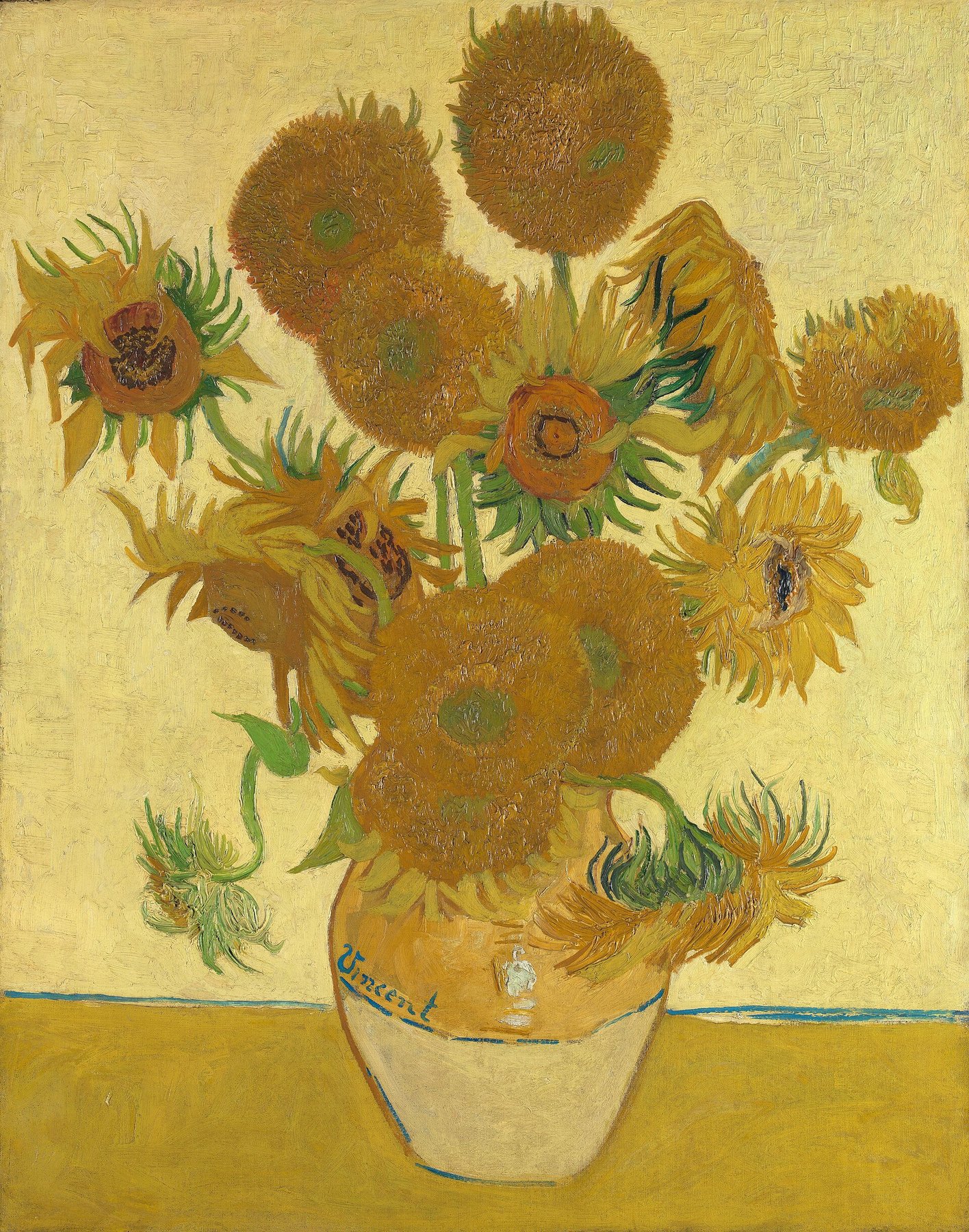
The picture shows cut sunflowers in a bulbous two-tone vase against a flat yellow ground, resting on a table indicated by a single blue line. Fifteen flower heads are visible, at wildly different stages: some dense with seed, some reduced to petals, two broken stems lying on the table. There is no background scenery and almost no depth — colour does the work that space would normally do.
It is one version of a series. Van Gogh had painted sunflower still lifes in Paris in 1887, and in Arles he pushed the subject further, producing several vases of sunflowers in August 1888 and repeating the compositions the following January at Gauguin's request. Versions now hang in London, Munich, Amsterdam, Philadelphia and Tokyo; another was destroyed in Japan during the Second World War. The London picture is an original August 1888 canvas, not a later repetition.
Arles, August 1888: the Yellow House and Gauguin
Van Gogh had moved to Arles in February 1888 chasing the light of the south, and by summer he was renting rooms in a house on the Place Lamartine, the Yellow House. His plan was a shared studio for artists, and Paul Gauguin had agreed to come. Preparing for that arrival became an obsession: furniture, walls, and above all decoration — a set of paintings for the room kept for the guest.
The sunflowers were that decoration. Writing about the project, Van Gogh described working on whole bunches of sunflowers from early morning, in a heat he found productive. Gauguin arrived in October 1888, admired the sunflower pictures and later painted Van Gogh at work on them. The collaboration collapsed within weeks, but the decoration outlived it, and the repetitions of January 1889 show how much the series meant to the painter himself.
How the painting is built
The technical gamble of the picture is that almost everything is yellow, and it still separates into planes. Van Gogh manages this with temperature and touch: the ground is a paler, flatter chrome yellow, the vase shifts towards ochre, the table's blue line cuts the composition, and the flowers themselves range from lemon to orange-brown at the seed heads. Contours are drawn rather than modelled, as in a decorated panel.
The brushwork is direct and unretouched. Petals are single strokes, some loaded thickly, some dragged nearly dry; the seed heads are stippled dots of thick paint. The different angles of the heads — facing the viewer, in profile, drooping — create a rhythm of circles and ellipses. Nothing is hidden or corrected, which is why the painting reads as confident rather than careful, and why copies with softened brushwork immediately feel wrong.
Fading, viewing and what a replica can recover
The yellows are not as permanent as they look. The chrome yellow Van Gogh favoured is chemically prone to change, and museum research has documented darkening and browning in chrome-based passages of the Arles paintings. The National Gallery monitors its sunflowers closely and keeps light levels low, so what you see today is a managed version of a slowly shifting original.
A hand-painted replica can follow the composition, the fifteen heads and the rhythms of brushwork faithfully, and modern stable pigments can match the intended range of yellows without inheriting the fading problem. What it cannot do is replicate the specific chemical history of Van Gogh's chrome yellows or the exact surface of his impasto. For a painting whose effect depends on colour against colour rather than fine detail, a good oil replica on canvas, at the true 92.1 × 73 cm, holds up unusually well.
If you want it on your wall
Sunflowers, hand-painted for your size
The same composition, painted in oil on cotton canvas by hand — from $189, in any proportional size, with six frame options and a numbered certificate of authenticity. It is a modern reproduction, not an antique, and the certificate says so; what it is not is a canvas print with a texture filter over it.
Free worldwide shipping, rolled in a rigid tube. Custom sizes and framing are quoted on the page.
Questions
Questions about Sunflowers
The best-known group is the Arles series of vases with sunflowers, painted in August 1888 and repeated in January 1889. Surviving versions are in the National Gallery in London, the Neue Pinakothek in Munich, the Van Gogh Museum in Amsterdam, the Philadelphia Museum of Art and the Sompo Museum in Tokyo, and one version was destroyed in Japan in 1945. He had also painted sunflower still lifes in Paris in 1887.
He was decorating. In August 1888 Van Gogh was furnishing the Yellow House in Arles for Gauguin's arrival and wanted a set of pictures for the guest room, with sunflowers as the subject. Gauguin arrived in October, admired the canvases, and later painted Van Gogh working on a sunflower still life. After the artists separated in December, Van Gogh returned to the subject and made repetitions the following January.
Some of the paint is chemically unstable. The chrome yellow pigments used in 1888 can darken or brown over time, and scientific studies of the Arles canvases have documented such changes in the yellows. Museums respond with strict light limits and climate control rather than repainting the colour. So the pictures you see are stable now, but not chemically identical to what left the studio.
There is no single original: the series is the original. The version usually meant — fifteen sunflowers in a yellow vase — hangs in the National Gallery in London and was painted in Arles in August 1888. The Munich version is close in date and design, while the Amsterdam, Philadelphia and Tokyo canvases are later repetitions from January 1889. Anyone selling the original as one object is simplifying.
More masterpieces
Vincent van Gogh
Café Terrace at Night
In September 1888 Van Gogh painted the Place du Forum in Arles at night using blues, greens and yellows, and told his sister he ha
Sandro Botticelli
The Birth of Venus
Botticelli's Birth of Venus is a tempera-on-canvas mythological scene from Florence, and some of its best-known stories — the patr
Rembrandt van Rijn
The Night Watch
Rembrandt's Night Watch shows a militia company setting out in daylight; its famous name comes from darkened varnish, and a strip
Want Sunflowers at your own size?
Tell us the wall and we will quote the canvas — hand-painted in oil, rolled and shipped free, with a numbered certificate.