Vincent van Gogh · 1888
Café Terrace at Night: how Van Gogh painted night without black
In September 1888 Van Gogh painted the Place du Forum in Arles at night using blues, greens and yellows, and told his sister he had done it without any black.
Published 29 October 2026
| Artist | Vincent van Gogh |
|---|---|
| Painted | 1888 |
| Medium | Oil on canvas |
| Size | 80.7 × 65.3 cm |
| Collection | Kröller-Müller Museum, Otterlo |
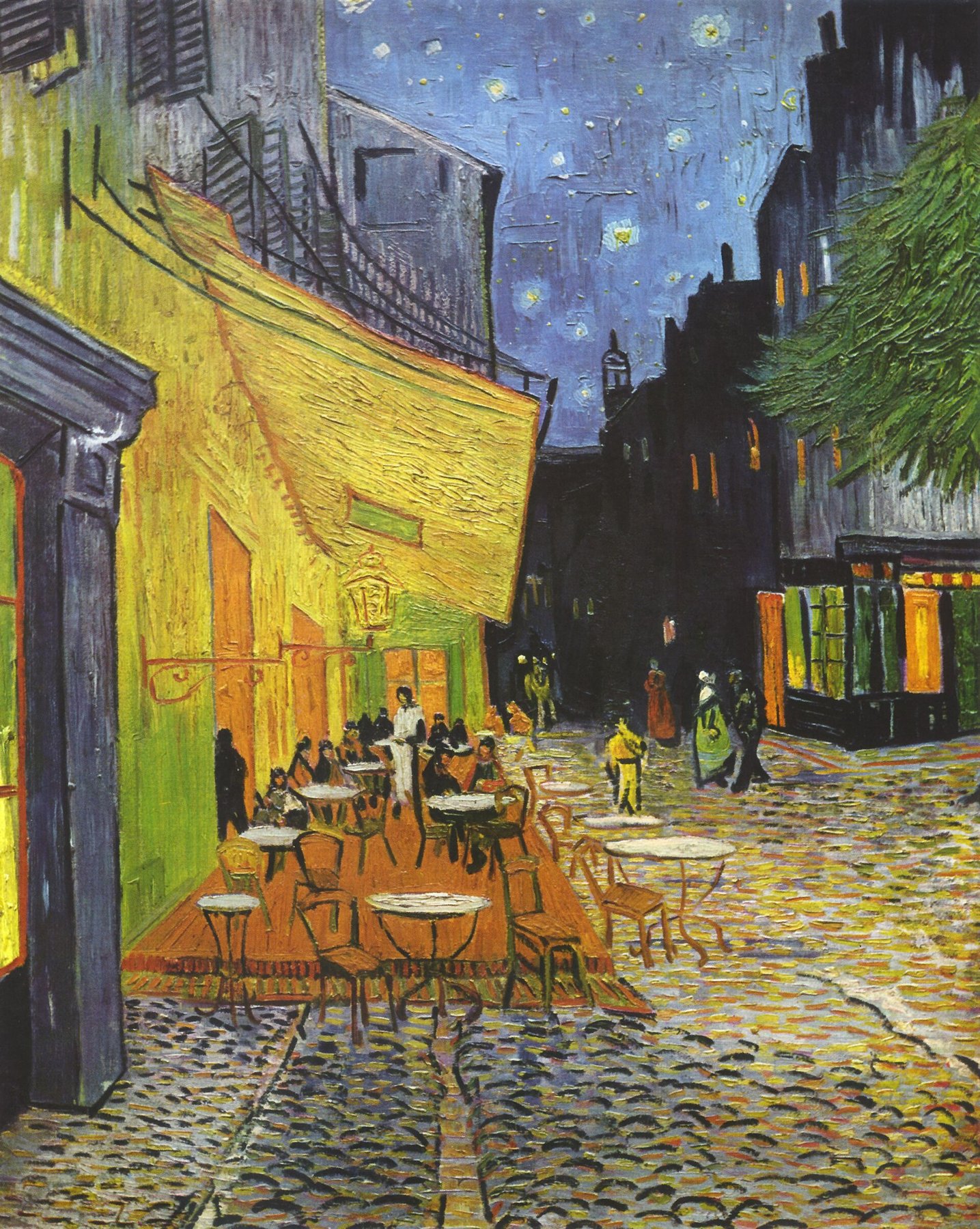
Café Terrace at Night — listed in some places as Place du Forum, Arles — is an oil on canvas of 80.7 × 65.3 cm, painted in September 1888 and held by the Kröller-Müller Museum in Otterlo, in the Netherlands. It shows the lit terrace of a café on the square in Arles, seen from across the street, with the road running into the dark beyond.
Its fame rests on a technical claim Van Gogh made himself. Writing to his sister Willemien, he described the picture as a night scene painted without black, built from blue, green and pale yellow instead. This article covers the object, the Arles context, how the colour system works, and what to expect from the original and from a replica.
What the painting shows and where it is
The view is straightforward: a café terrace under a large yellow-lit awning on the left, waiters and seated figures, a street receding towards a dimly lit tower, and a deep blue night sky with a scattering of stars above the rooftops. The square is the Place du Forum in Arles, and the building is identified with a café that still trades on the spot today under Van Gogh's name.
The canvas belongs to the Kröller-Müller Museum in Otterlo, which holds one of the largest Van Gogh collections in the world. In reproduction the picture drifts easily: many versions exaggerate the yellow, others the blue, and few manage the balance between the warm terrace and the cool street that the museum's own photography shows.
Arles in September 1888
Van Gogh arrived in Arles in February 1888, and the autumn found him at his most productive, painting out of doors and planning the shared studio in the Yellow House with Gauguin. September was a month of night paintings: around the same stretch he produced Starry Night Over the Rhône, and the café terrace belongs to the same season of evenings. He was also, by his own account, walking past this square often; the café was a few minutes from his lodgings, and the view was one he could study rather than imagine.
The letter to his sister Willemien sets out his intention. He described painting a night scene without black, using instead a fine blue and pale green with yellow and lemon green, and remarked that painting night effects on the spot, rather than from drawings, was a challenge he enjoyed. The picture is therefore a deliberate experiment, made during one of the calmest and most confident stretches of his career.
Why the colour system works
The structural idea is that night is built from complementary pairs rather than darkness. The awning's yellow and the street's blue-violet sit opposite each other, and their meeting divides the picture into warm and cold halves. Shadow is never black: the underside of the awning, the doorways and the cobbles all resolve into blues and greens, so the light reads as coming from the lamps alone.
The perspective does quiet work. The lines of the buildings and the street converge towards a point near the tower, pulling the eye away from the café into the dark, while the terrace's zigzag edge keeps bringing attention back to the light. Figures are small and loosely stated — a white-clad figure near the centre is sometimes read as the painter himself, though that is speculation rather than a documented identification.
Seeing it, and replicating it
In Otterlo the canvas again surprises with its size — modest, closer to a portrait than to an epic. What photographs flatten is the transition zone where yellow light spills onto blue cobbles: those passages are made with quick, confident strokes, and at viewing distance the picture reads far brighter than its palette suggests. It is also a rare Van Gogh in which the buildings are more carefully drawn than the people; the figures exist to give the architecture a scale and a heartbeat.
A hand-painted replica suits this painting well: the composition is architectural, the brushwork is visible but not intricate, and the whole effect is colour against colour, which oil handles directly. The honest limits are the same as with any Van Gogh — the specific speed of his touch and the surface of the original canvas cannot be duplicated — but for a painting built from planes of light, a careful oil replica at 80.7 × 65.3 cm comes genuinely close to the visual experience.
If you want it on your wall
Café Terrace at Night, hand-painted for your size
The same composition, painted in oil on cotton canvas by hand — from $189, in any proportional size, with six frame options and a numbered certificate of authenticity. It is a modern reproduction, not an antique, and the certificate says so; what it is not is a canvas print with a texture filter over it.
Free worldwide shipping, rolled in a rigid tube. Custom sizes and framing are quoted on the page.
Questions
Questions about Café Terrace at Night
That is his own account. In a letter to his sister Willemien written in September 1888, he described the picture as a night scene without any black, made with blue, pale green and yellow. The canvas supports him: shadows and dark areas resolve into blues and greens, and the deep night sky is built from blue pigment rather than from black.
The square is: the painting shows the Place du Forum in Arles, and the corner building with the terrace is identified with a café operating on that spot today, trading under Van Gogh's name with a yellow-lit terrace matching the picture. Arles also marks the Yellow House site, though the house itself no longer stands, having been destroyed during the Second World War.
It hangs in the Kröller-Müller Museum in Otterlo in the Netherlands, which built one of the world's largest Van Gogh collections in the early twentieth century under Helene Kröller-Müller. The painting does travel for exhibitions, so the museum's website is the reliable source for its current location, but Otterlo is its permanent home.
In September 1888, during his first year in Arles and a few weeks before Gauguin joined him in the Yellow House. The painting belongs to a group of night scenes from that period, alongside Starry Night Over the Rhône, and Van Gogh described it in a letter to his sister as a deliberate experiment in painting night without using black pigment.
More masterpieces
Vincent van Gogh
Sunflowers
The Arles Sunflowers in London was painted in August 1888 to decorate the room Van Gogh had prepared for Gauguin, and its famous y
Edvard Munch
The Scream
Munch's The Scream exists in four versions, two of which have been stolen and recovered, and the 1893 original in Oslo is smaller,
Caspar David Friedrich
Wanderer above the Sea of Fog
Friedrich's Wanderer above the Sea of Fog is not a view of one real mountain but a composed landscape, assembled from studies, and
Want Café Terrace at Night at your own size?
Tell us the wall and we will quote the canvas — hand-painted in oil, rolled and shipped free, with a numbered certificate.