Johannes Vermeer · c.1665
Girl with a Pearl Earring: 44.5 cm of a girl who was never anyone in particular
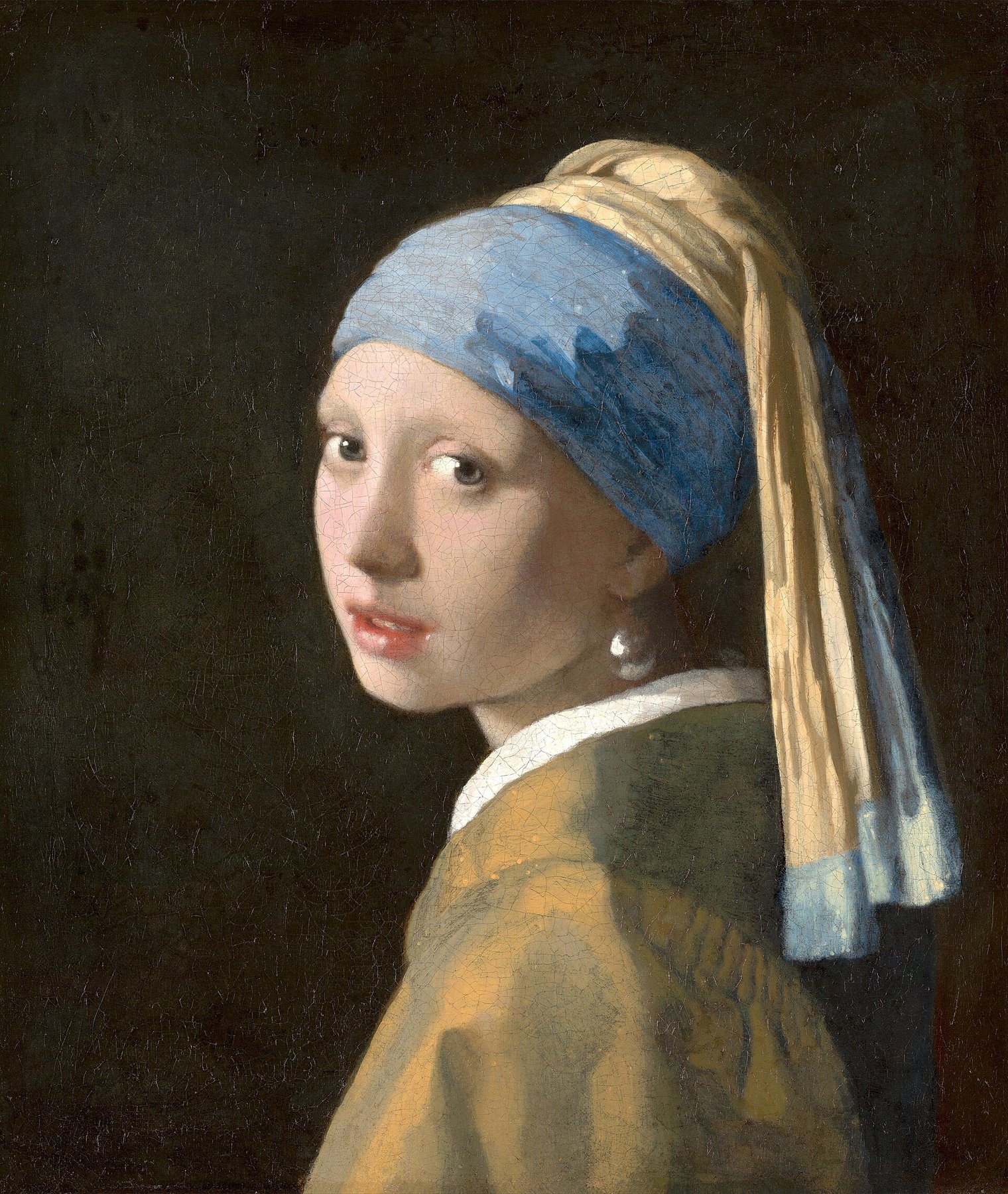
Vermeer painted her around 1665 as a tronie — a study of a head rather than a portrait of a sitter — which is why nobody has ever been able to say who she is.
Published 29 October 2026
| Artist | Johannes Vermeer |
|---|---|
| Painted | c.1665 |
| Medium | Oil on canvas |
| Size | 44.5 × 39 cm |
| Collection | Mauritshuis, The Hague |
Oil on canvas, 44.5 by 39 cm, in the Mauritshuis in The Hague. Painted around 1665, in the last decade of Vermeer's working life; he died in 1675, aged forty-three. The painting is small — a little larger than a sheet of A3 — and it is a head and one shoulder, cut off at the chest, against a dark ground with no setting, no window and no room behind her.
It came to the museum by a route that says something about how reputations move. It was bought at a Hague auction in 1881 for two guilders and thirty cents by Arnoldus Andries des Tombe, a collector who cannot have known what he was buying, and he left it to the Mauritshuis in 1902. It became one of the most reproduced faces in European painting only in the twentieth century, long after it was painted.
A head, not a person
A tronie is a seventeenth-century Dutch term for a head study: a face, often in costume, painted to show character, expression or technique rather than to record an individual. Vermeer made few of them and this is the best known. There is no name, no coat of arms and no inscription; the turban and the pearl are dress, not identity, and the pose — turning back over the shoulder — is a device for catching the viewer, not a description of a moment.
That is why the question of who she was has no answer that can be documented. She was a model, and the face may be partly invented. Attempts to identify her with a daughter, a servant or a particular Delft family have produced conjecture and nothing else. What can be said is that the type was recognised: a girl in oriental dress, lit from one side, looking straight out of the picture, belonged to a genre Dutch buyers knew.
Vermeer in Delft, at the end of his run
Vermeer worked slowly and produced little. About thirty-five paintings are accepted, and only a handful carry dates. He ran the family business as an art dealer, sat on the Guild of St Luke, converted to Catholicism before his marriage, and lived in his mother-in-law's house in the Papist corner of Delft. In his last years the market turned, and he died in debt; the estate was wound up to pay creditors.
His interiors are built on a window at the left, a cool north light, the same floor tiles and the same chairs from picture to picture. This one has none of that furniture. Remove the room, the map on the wall and the tiled floor, and what is left is a single head against nothing — which is exactly the experiment the painting performs, and the reason it looks more modern than the interiors that surround it in the same gallery.
Why it works
The design is three shapes: dark ground, lit face, blue turban. The shoulder turns away from us while the head comes back towards us, so the body makes a diagonal and the eyes are the only thing meeting the viewer directly. The blue is natural ultramarine, expensive at the time, and it is the largest area of saturated colour in the picture; the warm shadow of the cheek is its exact opposite, and the two hold the head between them.
The pearl is the brightest point and it is made of two strokes: a soft grey shadow and a hard white highlight, with no outline and almost no detail. At 39 cm across, those two strokes do all the work. Research published in 2018 suggested the object may not be a pearl at all — it is very large, and no hook or suspension was found — and that the background was originally a translucent greenish glaze that has since darkened. What we see is not quite what left the studio.
In the room, and in a copy
It hangs in the Mauritshuis among the other Dutch pictures, at a size that surprises people: 44.5 cm tall, a large book. The thinness of the glazes, the way the light sits in the turban and the fine crack pattern across the surface are only visible up close, in a room where the light is controlled and there is no glass between you and the paint. Most reproductions enlarge her, which changes the picture's character.
A painted copy can carry the pose, the colour relation between the blue and the warm ground, the hard edge of the highlight, and at 44.5 by 39 cm it will hold a small wall the way the original holds one. It cannot reproduce the craquelure, the translucency of a seventeenth-century glaze over a chalk ground, or the fact that the background has shifted colour with age. That last point is worth saying plainly: the black we admire is not the black Vermeer left.
If you want it on your wall
Girl with a Pearl Earring, hand-painted for your size
The same composition, painted in oil on cotton canvas by hand — from $189, in any proportional size, with six frame options and a numbered certificate of authenticity. It is a modern reproduction, not an antique, and the certificate says so; what it is not is a canvas print with a texture filter over it.
Free worldwide shipping, rolled in a rigid tube. Custom sizes and framing are quoted on the page.
Questions
Questions about Girl with a Pearl Earring
Probably not a pearl. It is very large, and research in 2018 found no hook or means of hanging it, which suggests polished tin, glass or another imitation. What matters visually is two strokes of paint — a grey shadow and a white highlight — rather than the material of the object she wears.
Unknown, and likely never a specific person. The picture is a tronie, a head study made to show a type and a technique rather than to record a sitter, so no name was attached to it, and none appears in any early inventory. Suggestions that she was Vermeer's daughter or a servant are guesses without documentary support.
44.5 by 39 cm, oil on canvas — small enough to carry under one arm. That scale is part of the effect: the head is close to life size, so standing in front of it feels like standing in front of a person rather than a monument. Reproductions usually enlarge it.
Because it is costume. Turbans and oriental dress were a standard device in Dutch head studies, part of a fashion for the exotic that came with trade and travel, and they let a painter show off blue and yellow without the constraints of contemporary dress. It is not a religious garment and not evidence about her.
More masterpieces
Leonardo da Vinci
Mona Lisa (La Gioconda)
Leonardo began the portrait around 1503, kept it for the rest of his life, carried it to France and never delivered it to the man
Gustav Klimt
The Kiss (Der Kuss)
Klimt finished it in 1908, the Austrian state bought it the same year, and it has hung in Vienna ever since — 180 cm square, oil a
Vincent van Gogh
The Starry Night
Van Gogh painted this in the summer of 1889 from a room in the asylum at Saint-Rémy, and the village underneath the sky is not the
Want Girl with a Pearl Earring at your own size?
Tell us the wall and we will quote the canvas — hand-painted in oil, rolled and shipped free, with a numbered certificate.