Vincent van Gogh · 1889
The Starry Night: the painting Van Gogh thought was a failure
Van Gogh painted this in the summer of 1889 from a room in the asylum at Saint-Rémy, and the village underneath the sky is not the village he could see from his window.
Published 29 October 2026
| Artist | Vincent van Gogh |
|---|---|
| Painted | 1889 |
| Medium | Oil on canvas |
| Size | 73.7 × 92.1 cm |
| Collection | Museum of Modern Art, New York |
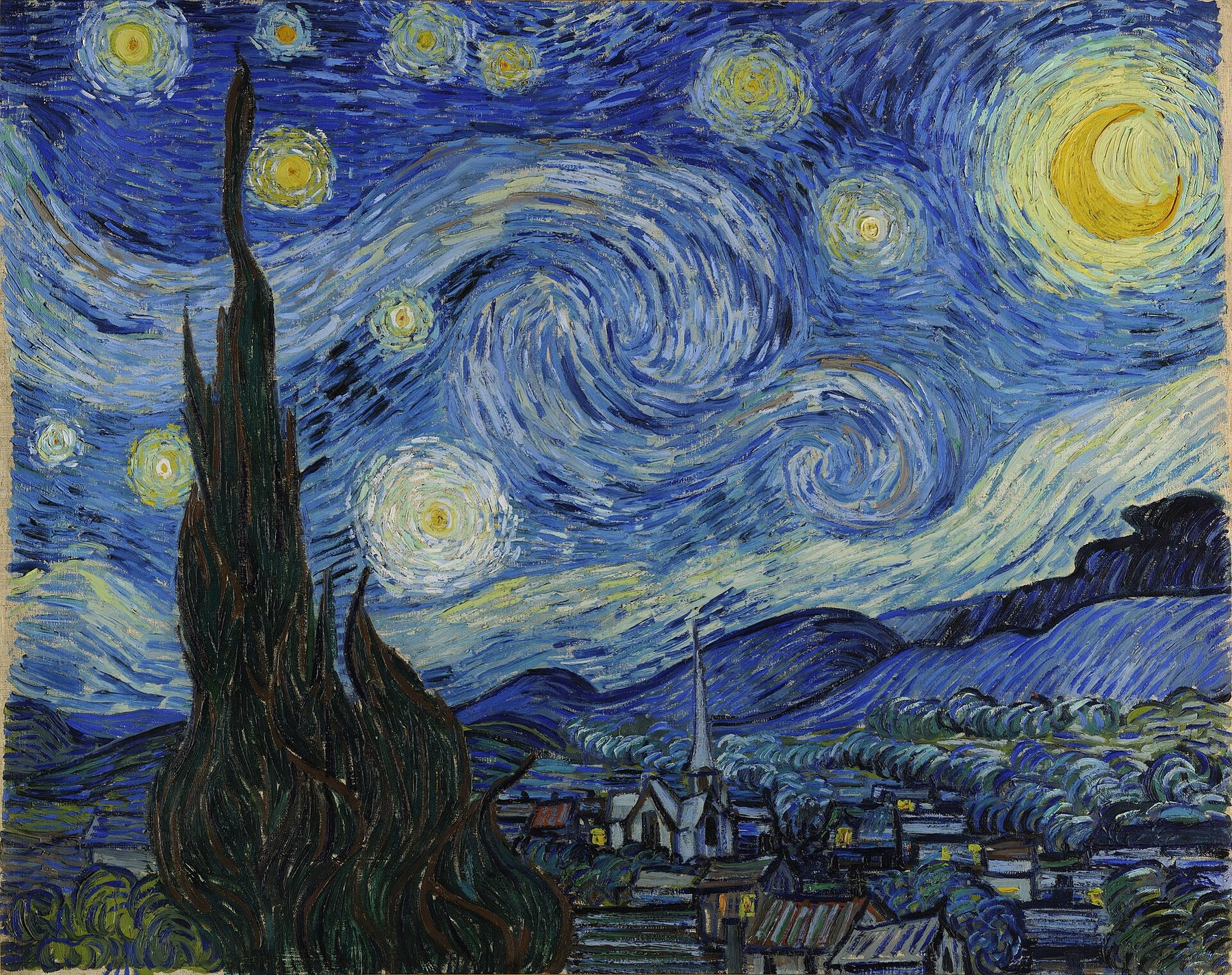
Oil on canvas, 73.7 by 92.1 cm, painted in the summer of 1889 and bought for the Museum of Modern Art in 1941 with the Lillie P. Bliss bequest. Van Gogh made it inside the asylum at Saint-Rémy-de-Mausole, in a room he used as a studio, by daylight. He could not sit under that sky at night, so the picture was built from drawings, from memory and from a view he had been looking at for weeks.
The painting's problem is its reputation. It has been printed on socks and phone cases for so long that most people have stopped seeing it as a picture — as a made object with a decision at every centimetre. In the letters it is a study among studies rather than a summing-up, and Van Gogh was not satisfied with it. That is the more interesting object, and it is the one worth looking at.
What is actually on the canvas
Two thirds of the height is sky. A crescent moon sits at the upper right, and a single enormous star hangs left of the cypress, usually identified as Venus — the morning star he had described to his brother from the window before dawn. Around the smaller stars the light is drawn as rings of broken strokes rather than blurred, so each one reads as a small engine. Below: a band of hills, a village with a spired church, and the cypress running from the bottom edge almost to the top.
The village is not the one outside his window. Saint-Rémy has no church with a spire that steep, and writers have long noted that the tower looks Netherlandish, closer to the church at Nuenen where his father preached than to anything in Provence. He could see the Alpilles from the asylum, but the valley in the painting is assembled. The cypress is placed rather than observed: he had painted cypresses along the roads at Arles the year before, and here one is moved into the foreground to do a job.
The room, and the year
He committed himself to Saint-Paul-de-Mausole in May 1889, five months after the quarrel with Gauguin in Arles that ended with the cut ear and a stay in hospital. The asylum was a former monastery with a walled garden, and he was given two rooms, one of them a studio with a window. He was allowed to paint in the grounds and, with an attendant, outside the walls. In the year he spent there he painted a great deal — irises, olive groves, the garden, the view from the window — and the output belongs to a man who was, for long stretches, calm.
He had painted night before. At Arles in 1888 he set up outdoors after dark and painted the café terrace under gaslight, and the Rhône with its lamps doubled in the water, and he wrote then about wanting a sky full of stars. The Saint-Rémy picture is different in kind: it is the one major night painting made without the motif in front of him, at the hour when he could not be outdoors, which is why its sky behaves like a diagram of night rather than a record of one.
Why the composition holds
The structure is simpler than it looks. Two horizontal bands — hills, then village — sit low, and one dark vertical, the cypress, crosses them and nearly reaches the top edge. Without that tree the eye would slide off the left of the canvas and the sky would be decoration above a landscape. With it, the picture has a spine, and the swirl turns around a centre the tree anchors. The moon and the bright star set a second axis, diagonal, so the sky is not a flat field but a system with poles.
The colour is a straight complementary opposition: blue ground, yellow and white light, with the cypress a near-black green that reads as the darkest note and holds the whole thing down. What makes it more than a colour exercise is the direction of the strokes. They follow the imagined movement of the air — long, loaded, curving — and they change at the hills, which are painted in horizontals. The sky is not a backdrop. It is a separate weather system with its own grain, laid over a landscape painted at a different pace.
Standing in front of it now
On a phone the painting reads as flat pattern. In the room the surface is a relief: the sky's strokes stand up from the canvas and throw small shadows, and the blues are not one blue but several, laid side by side so that they mix in the eye at three metres and separate at one. The canvas is about the size of a small window, 92 cm across, and it was made to be seen at that distance rather than at poster scale.
This is where a copy has to be honest. A hand-painted version at 73.7 by 92.1 cm can carry the drawing, the proportions, the colour relations and the direction of the strokes, and at arm's length it will do what the original does. It cannot carry the relief of paint that has had 130 years to settle, the weave underneath, or the exact behaviour of pigments that have darkened. Ours is an interpretation in oil, made to be lived with, not a facsimile.
If you want it on your wall
The Starry Night, hand-painted for your size
The same composition, painted in oil on cotton canvas by hand — from $189, in any proportional size, with six frame options and a numbered certificate of authenticity. It is a modern reproduction, not an antique, and the certificate says so; what it is not is a canvas print with a texture filter over it.
Free worldwide shipping, rolled in a rigid tube. Custom sizes and framing are quoted on the page.
Questions
Questions about The Starry Night
Nobody commissioned it. He had wanted a starry sky since Arles, where he painted the café terrace and the river at night, and at Saint-Rémy the view from his window before dawn gave him the subject he could not paint outdoors after dark. It was one canvas in a year of steady work, sent to his brother Theo with others, and it found no buyer.
Scholars disagree. Some astronomers have tried to match the crescent moon and the bright star — often read as Venus — to the sky over Provence in the summer of 1889; others point out that the positions do not fit any single night. The village and the cypress were rearranged anyway, so treat it as a composed sky rather than a record.
At the Museum of Modern Art in New York, on permanent display, where it has been since 1941. It was bought with the Lillie P. Bliss bequest and has not been on the market since. It travels rarely, and a loan is treated as an event. No sale price exists, which has never stopped the numbers that get printed.
Cypresses line the roads and cemeteries of Provence, and Van Gogh had painted them at Arles the year before. Here one is moved to the front and used as a dark vertical, tying the earth to the sky and stopping the eye from leaving the left edge. He wrote about the tree's colour and its shape more than once.
More masterpieces
Leonardo da Vinci
Mona Lisa (La Gioconda)
Leonardo began the portrait around 1503, kept it for the rest of his life, carried it to France and never delivered it to the man
Gustav Klimt
The Kiss (Der Kuss)
Klimt finished it in 1908, the Austrian state bought it the same year, and it has hung in Vienna ever since — 180 cm square, oil a
Claude Monet
Water Lilies (Nymphéas)
Monet painted the water garden at Giverny from 1899 until his death in 1926 — around 250 canvases of the same surface of water, en
Want The Starry Night at your own size?
Tell us the wall and we will quote the canvas — hand-painted in oil, rolled and shipped free, with a numbered certificate.