Gustav Klimt · 1907–1908
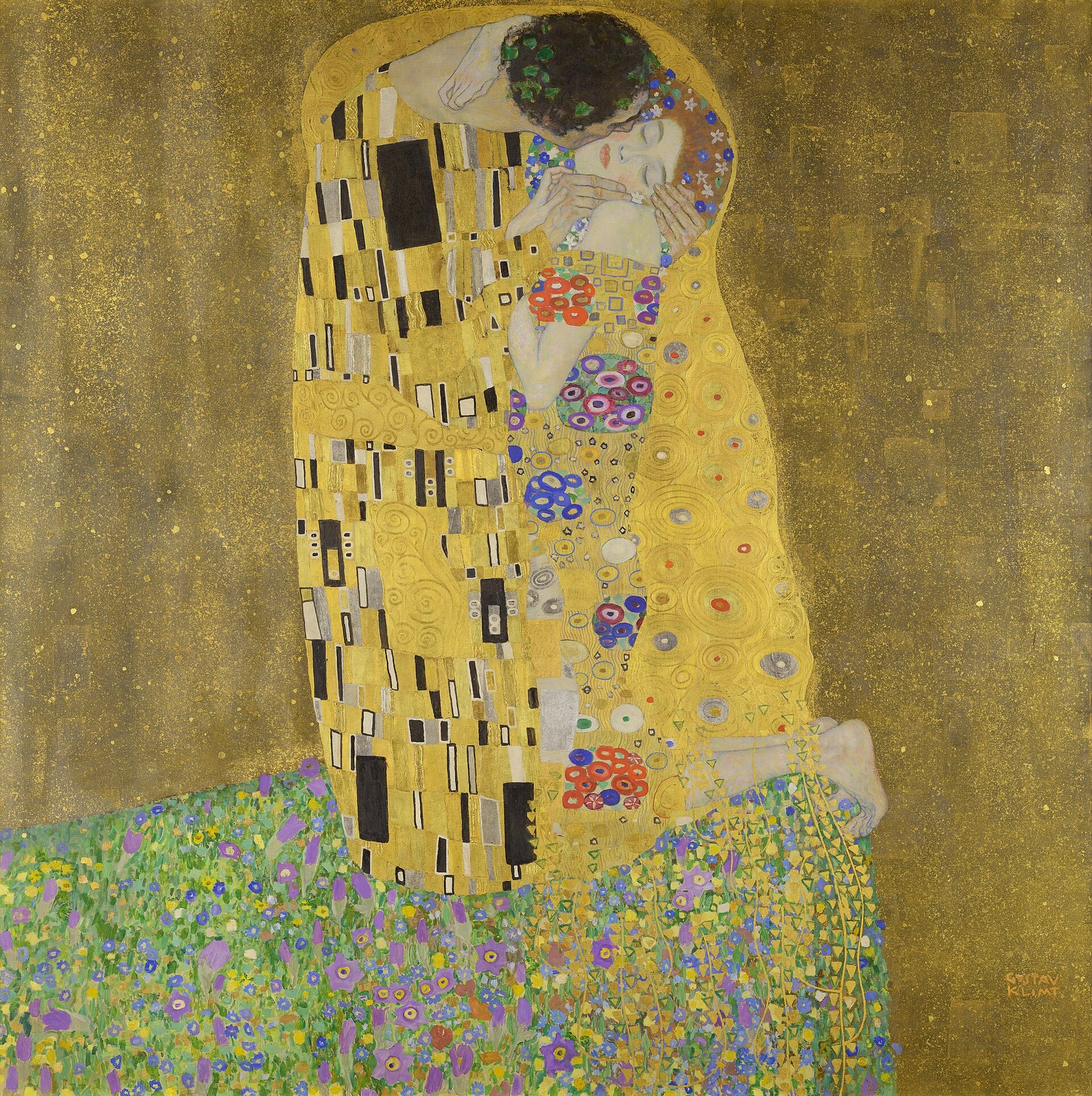
The Kiss: a square of gold in which only the faces, hands and feet are skin
Klimt finished it in 1908, the Austrian state bought it the same year, and it has hung in Vienna ever since — 180 cm square, oil and gold leaf, with almost no flesh in it at all.
Published 29 October 2026
| Artist | Gustav Klimt |
|---|---|
| Painted | 1907–1908 |
| Medium | Oil and gold leaf on canvas |
| Size | 180 × 180 cm |
| Collection | Österreichische Galerie Belvedere, Vienna |
180 by 180 cm, oil and gold leaf on canvas, in the Österreichische Galerie Belvedere. Painted in 1907 and 1908 and bought by the state in 1908 for the Moderne Galerie, the collection it still belongs to. A square format for a figure painting is unusual, and it is the first thing you register in the room: no portrait proportions, no landscape rectangle, just a field with two people in it.
The second thing is how little of the picture is body. Faces, hands, feet — that is the whole extent of the flesh. Everything else is pattern: a gold cloak cut into rectangles, a dress covered in ovals and circles, a ground of flowers. Klimt built the picture so that the two heads are the only place where paint has to behave like skin, and the gold makes that skin look warmer and more alive than it would against any other ground.
Two figures, no portrait
The man's face is turned away, pressed into the woman's cheek; hers is in profile, eyes closed, tilted back. Neither is identifiable, and there is no evidence that this is a double portrait. The suggestion that it shows Klimt with Emilie Flöge has been repeated for a century without documentation. It was painted for exhibition, not commissioned by a sitter, and it was shown at the Kunstschau in Vienna in 1908, where the state bought it.
The anonymity is the point. With no face to read on the man, the picture is about the enclosure rather than the couple: the gold wraps them into one mass from which two heads emerge, and the woman's bare feet hang over the edge of the flowered ground, which drops away like a ledge rather than continuing as a meadow. There is no room, no window, no furniture — only the pair and the drop.
Where the gold came from
Klimt's father, Ernst, was a gold engraver, and Klimt grew up around the trade before he used leaf on a canvas. In 1903 he travelled in Italy and saw the mosaics at Ravenna, where gold ground is not decoration but a way of removing space from a picture. From about 1901 gold enters his work; by 1907, in the first portrait of Adele Bloch-Bauer, and here in 1908, it is structural rather than ornamental.
Laying leaf is a different craft from painting. Gold is applied over a size on top of the painted surface, in overlapping squares, and it takes the light of the room instead of holding a colour of its own. Klimt could not judge the final balance while he worked, because leaf only begins to behave once it is down. The consequence is that the gold is not a colour but a mirror: the picture changes with the hour and with the wall opposite it.
Why it holds together
The composition runs on an opposition of patterns. The man's garment is cut into rectangles and hard vertical bands, dark and angular; the woman's is a field of ovals and circles, pale, with flower shapes inside them. At a distance the two patterns form one shield around the heads. Close up they are two incompatible systems that meet at the hands, which is where the picture's only real contact happens.
The edges do the rest. The ground is a ledge, the figures kneel at its lip, and the man's feet run off the right edge of the canvas, so there is no floor to stand on. Gold flattens the space and throws the two faces forward; the modelling in those faces is soft and conventional, and it reads as three-dimensional only because everything around it refuses to be. Take the gold away and the same heads would look ordinary.
In the room, and in a copy
At the Belvedere it hangs in a room of its own, and the leaf catches the window light; step to one side and the gold goes dark, leaving the faces to carry the picture alone. Up close the surface is uneven — leaf over paint, some squares lifting slightly at the edges, fine cracks running through the metal. Very little about it is smooth, which reproductions never show.
A hand-painted copy at 180 cm can hold the drawing, the two patterns, the warmth of the flesh against the gold and the weight of the square. What it cannot hold is real leaf. Gold paint is a pigment with a colour; leaf is a metal that reflects, and a copy made with metallic paint looks even and slightly flat beside the original. Scale matters too: at 180 cm the figures have room, and at 100 cm the pattern tightens around them.
If you want it on your wall
The Kiss (Der Kuss), hand-painted for your size
The same composition, painted in oil on cotton canvas by hand — from $189, in any proportional size, with six frame options and a numbered certificate of authenticity. It is a modern reproduction, not an antique, and the certificate says so; what it is not is a canvas print with a texture filter over it.
Free worldwide shipping, rolled in a rigid tube. Custom sizes and framing are quoted on the page.
Questions
Questions about The Kiss (Der Kuss)
Oil paint and gold leaf on canvas, 180 by 180 cm. The gold is laid in overlapping squares over a size on top of the painted surface, so the picture is part painting and part metal. That is why it looks different in every room and at every hour of the day.
Nobody knows, and the painting does not name them. It is an allegory rather than a portrait, made for exhibition in 1908. The idea that it shows Klimt with Emilie Flöge is a guess that has been repeated so often it sounds like fact; there is no documentation for it.
The gold, the embrace and the square format are instantly legible even at thumbnail size, which is what made it a poster. It was bought by the Austrian state straight from the 1908 Kunstschau exhibition, entered a public collection early, and has been in Vienna ever since — never sold, never hidden.
In the Österreichische Galerie Belvedere in Vienna, in the Upper Belvedere, where it hangs in a room of its own. It is the collection's best-known holding, so expect company. The room is worth a second pass at a different hour, when the light on the gold has changed.
More masterpieces
Vincent van Gogh
The Starry Night
Van Gogh painted this in the summer of 1889 from a room in the asylum at Saint-Rémy, and the village underneath the sky is not the
Leonardo da Vinci
Mona Lisa (La Gioconda)
Leonardo began the portrait around 1503, kept it for the rest of his life, carried it to France and never delivered it to the man
Claude Monet
Water Lilies (Nymphéas)
Monet painted the water garden at Giverny from 1899 until his death in 1926 — around 250 canvases of the same surface of water, en
Want The Kiss (Der Kuss) at your own size?
Tell us the wall and we will quote the canvas — hand-painted in oil, rolled and shipped free, with a numbered certificate.