Leonardo da Vinci · c.1503–1519
Mona Lisa: one poplar panel, 77 cm tall, and a smile that keeps moving
Leonardo began the portrait around 1503, kept it for the rest of his life, carried it to France and never delivered it to the man who ordered it — which is why the sitter is still argued about.
Published 29 October 2026
| Artist | Leonardo da Vinci |
|---|---|
| Painted | c.1503–1519 |
| Medium | Oil on poplar panel |
| Size | 77 × 53 cm |
| Collection | Musée du Louvre, Paris |
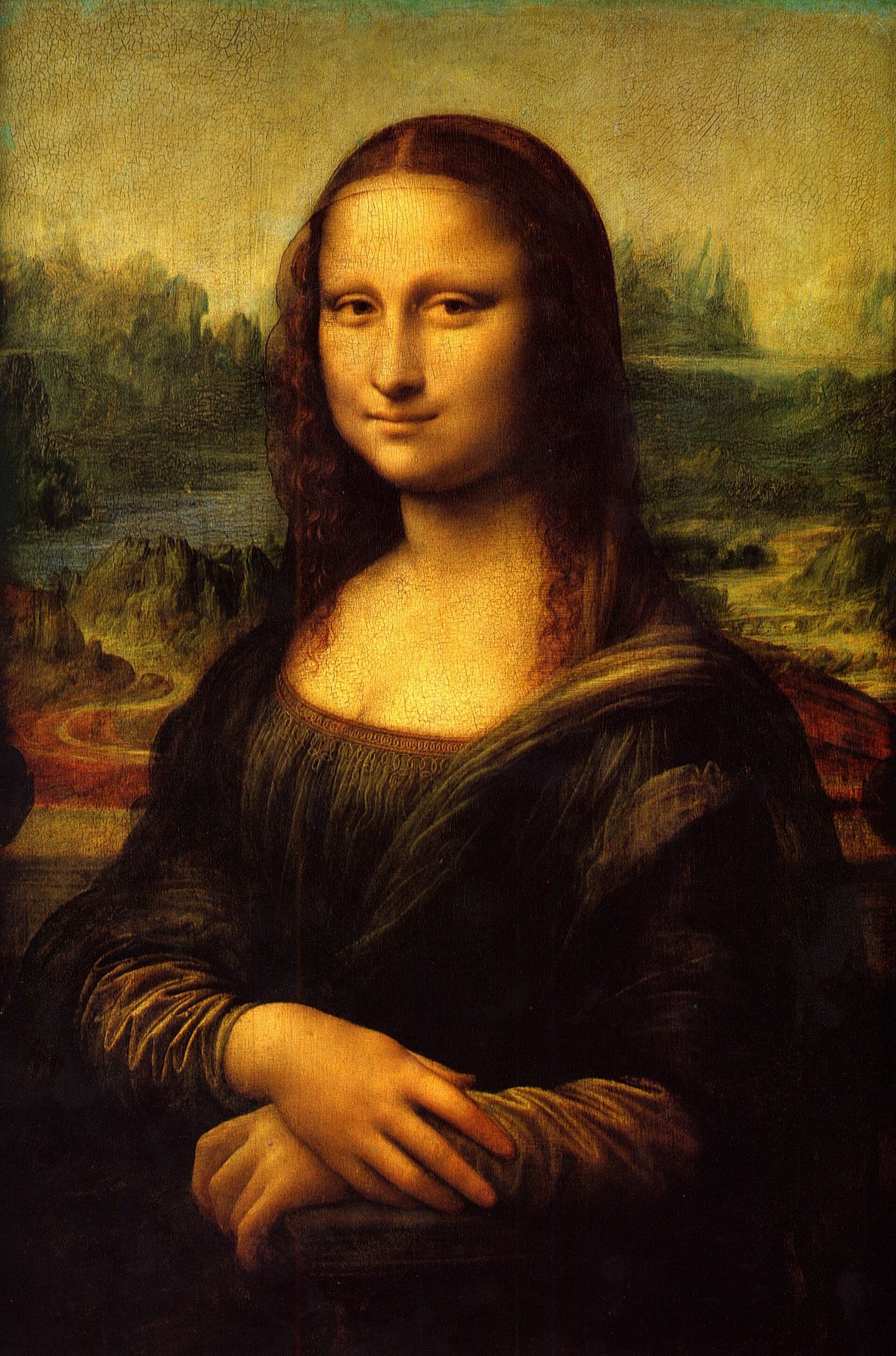
Oil on a single poplar panel, 77 by 53 cm, in the Musée du Louvre. The dates usually given are 1503 to 1519: begun in Florence, worked on for years, still being changed when Leonardo died at Amboise in 1519. Nothing is signed and nothing is dated on the front. The support is one board, thinly grounded, painted in layers so thin that in the flesh the ground still does part of the work.
That is the object. The fame is a separate story and it distorts the looking. Most visitors arrive expecting something enormous, find a small panel behind glass in a crowded room, and photograph it instead of seeing it. The useful question is not why it is famous but what Leonardo actually did on those four thousand square centimetres, and how much of it survives for us to look at.
Who the sitter probably is
The identification comes from Vasari, writing thirty years later: Lisa, daughter of Antonmaria Gherardini, born in Florence in 1479, married in 1495 to Francesco del Giocondo, a silk merchant. Hence La Gioconda, and hence the French title. Vasari also says the portrait was left unfinished, which fits a panel that Leonardo kept and reworked instead of delivering. He was not a painter who finished on schedule.
In 2005 a scholar found a handwritten marginal note in a copy of Cicero's letters, dated 1503, in which Agostino Vespucci lists Leonardo's work in progress and mentions a portrait of Lisa del Giocondo. That is the closest thing to contemporary evidence, and it supports the traditional identification without proving that this particular panel is the one described. A minority of scholars has proposed other sitters; the Gherardini reading remains the one most accept.
The years it took, and the journey to France
In 1503 Leonardo was in Florence, in his early fifties, working on the Battle of Anghiari for the Palazzo Vecchio and on anatomical studies, finishing neither. The portrait was made alongside that work and then kept, which is the important fact: it was never a transaction. He went on adding glazes over years, and the surface shows it — the transitions are built from layers so thin that the brushwork disappears and the edges of forms dissolve into one another.
In 1516 he accepted an invitation from Francis I and went to France, taking the panel with him. It entered the royal collection and has been French ever since, apart from a two-year absence in the early twentieth century. Poplar moves with humidity, and this panel has a slight curve and a network of fine cracks in the paint; both are part of how the picture now looks, and neither can be reproduced by painting.
Why the picture works
The composition is a pyramid with the hands as its base. The sitter is turned, the shoulders are not square to us, and the parapet behind her sets a horizontal that the figure interrupts. Early sources describe columns at the edges, which are missing: the panel appears to have been trimmed at some point, and the loggia she sits in is now only a suggestion of a ledge and a shadow. What is left is a figure with almost no architecture around her.
Two details repay close looking. The horizon does not line up: the one on the left sits lower than the one on the right, which makes the head feel slightly higher and the space slightly unstable. And the smile behaves oddly because it is painted in soft shadow rather than line, so it is clearer in peripheral vision than when looked at directly — a hypothesis rather than a fact, but one that matches most people's experience. There are no eyebrows, and whether they were painted and lost, or never painted, is still argued.
In the room, and in a copy
She hangs in the Salle des États, behind glass, in a room built for crowds. You stand three or four metres away, which is not close enough for the glazes. The tonality is greener and darker than reproduction suggests: varnish yellows, and five centuries of it sit between you and the paint. The most striking thing at that distance is how much of the picture is air — the blue-grey distance takes up a third of it.
A painted copy can do the softness. Oil is the right medium for sfumato, the same size is easy to match, and the drawing is available to anyone who looks carefully. What a copy cannot do is age: the amber varnish, the craquelure, the warmth of a poplar panel under thin paint. Hang a copy at eye level in a room rather than behind glass at three metres and you will see more of the picture than most visitors to the Louvre do.
If you want it on your wall
Mona Lisa (La Gioconda), hand-painted for your size
The same composition, painted in oil on cotton canvas by hand — from $189, in any proportional size, with six frame options and a numbered certificate of authenticity. It is a modern reproduction, not an antique, and the certificate says so; what it is not is a canvas print with a texture filter over it.
Free worldwide shipping, rolled in a rigid tube. Custom sizes and framing are quoted on the page.
Questions
Questions about Mona Lisa (La Gioconda)
Most scholars accept that she is Lisa Gherardini, born in Florence in 1479 and married to the silk merchant Francesco del Giocondo — the name La Gioconda comes from him. A 1503 note by Agostino Vespucci supports the identification. A minority has argued for other sitters, and the debate has never fully closed.
Not because of a single quality. The theft in 1911, when Vincenzo Peruggia walked out of the Louvre with the panel and kept it for two years, gave the painting a newspaper story that ran across the world; the empty wall and the recovery made it a celebrity. Leonardo's reputation and the smile did the rest.
Two explanations compete. Florentine women of the period often removed eyebrows and hairline hair, so she may never have had them; alternatively they were painted and lost in an early cleaning. Vasari describes eyebrows, which supports the second reading, but his description may be conventional rather than observed.
77 by 53 cm, oil on a single poplar panel — roughly the size of a large poster and much smaller than most people expect. It hangs behind glass in the Salle des États at the Louvre, in a climate-controlled case on a free-standing wall, which exaggerates the crowd and shrinks the picture still further.
More masterpieces
Johannes Vermeer
Girl with a Pearl Earring
Vermeer painted her around 1665 as a tronie — a study of a head rather than a portrait of a sitter — which is why nobody has ever
Gustav Klimt
The Kiss (Der Kuss)
Klimt finished it in 1908, the Austrian state bought it the same year, and it has hung in Vienna ever since — 180 cm square, oil a
Vincent van Gogh
The Starry Night
Van Gogh painted this in the summer of 1889 from a room in the asylum at Saint-Rémy, and the village underneath the sky is not the
Want Mona Lisa (La Gioconda) at your own size?
Tell us the wall and we will quote the canvas — hand-painted in oil, rolled and shipped free, with a numbered certificate.