Claude Monet · 1899–1926
Water Lilies: one pond, painted for twenty-seven years
Monet painted the water garden at Giverny from 1899 until his death in 1926 — around 250 canvases of the same surface of water, ending with eight panels in two oval rooms in Paris.
Published 29 October 2026
| Artist | Claude Monet |
|---|---|
| Painted | 1899–1926 |
| Medium | Oil on canvas |
| Size | Many versions, from small studies to panels over two metres high |
| Collection | Musée de l'Orangerie, Paris, and many other collections |
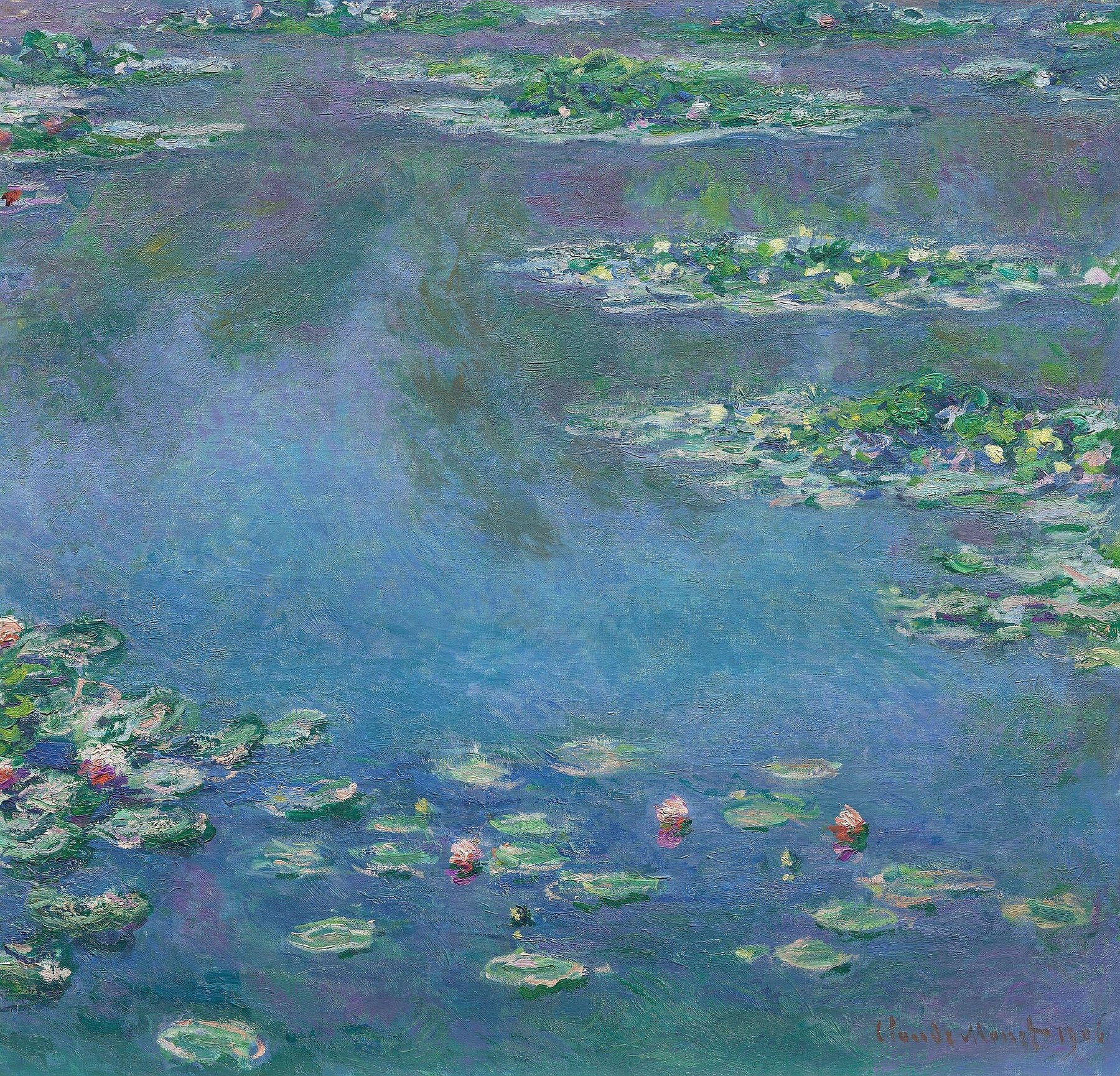
There is no single Water Lilies. The series runs from 1899, when Monet first set up at the edge of his pond, to 1926, the year he died; the count is usually given as about 250 paintings, from small studies to panels more than two metres high. The best-known group is the eight at the Musée de l'Orangerie in Paris, installed in 1927, a year after his death, in two oval rooms designed around them.
Almost all of them show the same thing: the surface of the pond at Giverny, with sky and willows reflected in it, and no bank, no horizon, no shore. That subtraction is the achievement. He spent the last third of his life taking everything out of the picture except water, and then painting the water until it stopped reading as water and started reading as paint.
The garden he built in order to paint it
Monet bought the house at Giverny in 1890 and made the water garden from 1893, diverting water from the Ru, a small branch of the Epte, to fill a pond. He planted water lilies, brought in exotic plants and built the Japanese bridge. Local farmers objected to the plants and to the diversion of the stream; he needed permission and got it. The garden was a construction, made for looking at, and it became the subject of the rest of his work.
He did not paint it as landscape. From 1899 he worked at the edge of the pond with several canvases going at once, moving between them as the light changed — the method he had used for the haystacks and the Rouen cathedral. The difference is that this motif was at his own door and repeatable every day for years, so he could wait for exact conditions instead of travelling to find them.
The horizon disappears
In the early water lily paintings there is still a bank at the top of the canvas, or a curve of the pond's edge, so the viewer knows where they are standing and which way the bank runs. By the late ones there is nothing: the whole surface is water, and the reflections of sky and willow are the only evidence of anything above. The picture becomes a vertical plane showing a horizontal surface — a contradiction the eye accepts because the paint is consistent across it.
That is why the late paintings get called precursors of abstraction. They are not abstract: there is still a pond, still lilies, still the reflection of a particular tree. But the subject has shifted from the thing to the surface, and the brushwork stops describing and starts recording the act of looking, which is a different job and the one that twentieth-century painting took up.
Colour, and the cataract years
The palette moves across the series. Early canvases are greens, blues and pinks, with water clear enough to see into; the late ones are darker and warmer, with more red and yellow, and the forms looser. Monet was diagnosed with cataracts in 1912 and operated in 1923. His colour sense was affected, and the late work is often read in that light. It is a reasonable reading, not a diagnosis of the paintings.
The Orangerie panels are the extreme case. Two metres high, several metres long, hung in curves and lit from above, they are the only Water Lilies where scale is part of the subject: you stand inside the painting instead of in front of it. Monet worked on them for years, destroyed some, and the installation was completed after his death, following the plan he had agreed with the state.
In the Orangerie, and on a domestic wall
The rooms were renovated in 2006 to bring back daylight, since Monet had designed them for natural light from above. The panels carry no frames; the paint simply stops where the wall curves. Seen there, the missing horizon does something physical: the eye has nowhere to rest and keeps travelling across the surface, which is the closest thing in a museum to sitting at the edge of water for twenty minutes.
A painting on a domestic wall cannot do that. At 100 or 120 cm you get the colour, the drawing of the lily pads and the structure of the reflections, and you lose the immersion, because immersion depends on the picture being wider than your field of view. What a hand copy can do honestly is the surface: the thin layers, the scumbled sky in the water, a stroke of pink sitting under a stroke of green. What it cannot do is two rooms of wall.
If you want it on your wall
Water Lilies (Nymphéas), hand-painted for your size
The same composition, painted in oil on cotton canvas by hand — from $189, in any proportional size, with six frame options and a numbered certificate of authenticity. It is a modern reproduction, not an antique, and the certificate says so; what it is not is a canvas print with a texture filter over it.
Free worldwide shipping, rolled in a rigid tube. Custom sizes and framing are quoted on the page.
Questions
Questions about Water Lilies (Nymphéas)
Around 250 paintings of the subject, made between 1899 and his death in 1926, in sizes from small studies to multi-metre panels. The number is approximate because the edges of the series are soft: pond views, lily studies and the huge decorative panels are usually counted together.
At the Musée de l'Orangerie in Paris: eight large panels in two oval rooms, installed in 1927, a year after Monet died. They were designed with the architect Camille Lefèvre following Monet's plan, and the rooms were renovated in 2006 to restore the natural light he had specified.
Because the light changed. From the 1890s he worked in series — haystacks, poplars, Rouen cathedral — with several canvases going at once, switching as the hour turned. The pond at Giverny let him do that at home, every day, for twenty-seven years, which no borrowed motif could.
Probably. He was diagnosed with cataracts in 1912 and operated in 1923, and the late paintings are warmer, redder and looser than the earlier ones. How much of that is the eye and how much is a deliberate late style is argued; the operation changed his colour perception in ways he complained about.
More masterpieces
Katsushika Hokusai
The Great Wave off Kanagawa
It is a colour woodblock print from Hokusai's Thirty-Six Views of Mount Fuji, made around 1830 to 1832, cut and printed by craftsm
Vincent van Gogh
The Starry Night
Van Gogh painted this in the summer of 1889 from a room in the asylum at Saint-Rémy, and the village underneath the sky is not the
Gustav Klimt
The Kiss (Der Kuss)
Klimt finished it in 1908, the Austrian state bought it the same year, and it has hung in Vienna ever since — 180 cm square, oil a
Want Water Lilies (Nymphéas) at your own size?
Tell us the wall and we will quote the canvas — hand-painted in oil, rolled and shipped free, with a numbered certificate.