Rembrandt van Rijn · 1642
The Night Watch is not a night scene: what Rembrandt painted in 1642
Rembrandt's Night Watch shows a militia company setting out in daylight; its famous name comes from darkened varnish, and a strip of the canvas has been missing since 1715.
Published 29 October 2026
| Artist | Rembrandt van Rijn |
|---|---|
| Painted | 1642 |
| Medium | Oil on canvas |
| Size | 363.8 × 437 cm |
| Collection | Rijksmuseum, Amsterdam |
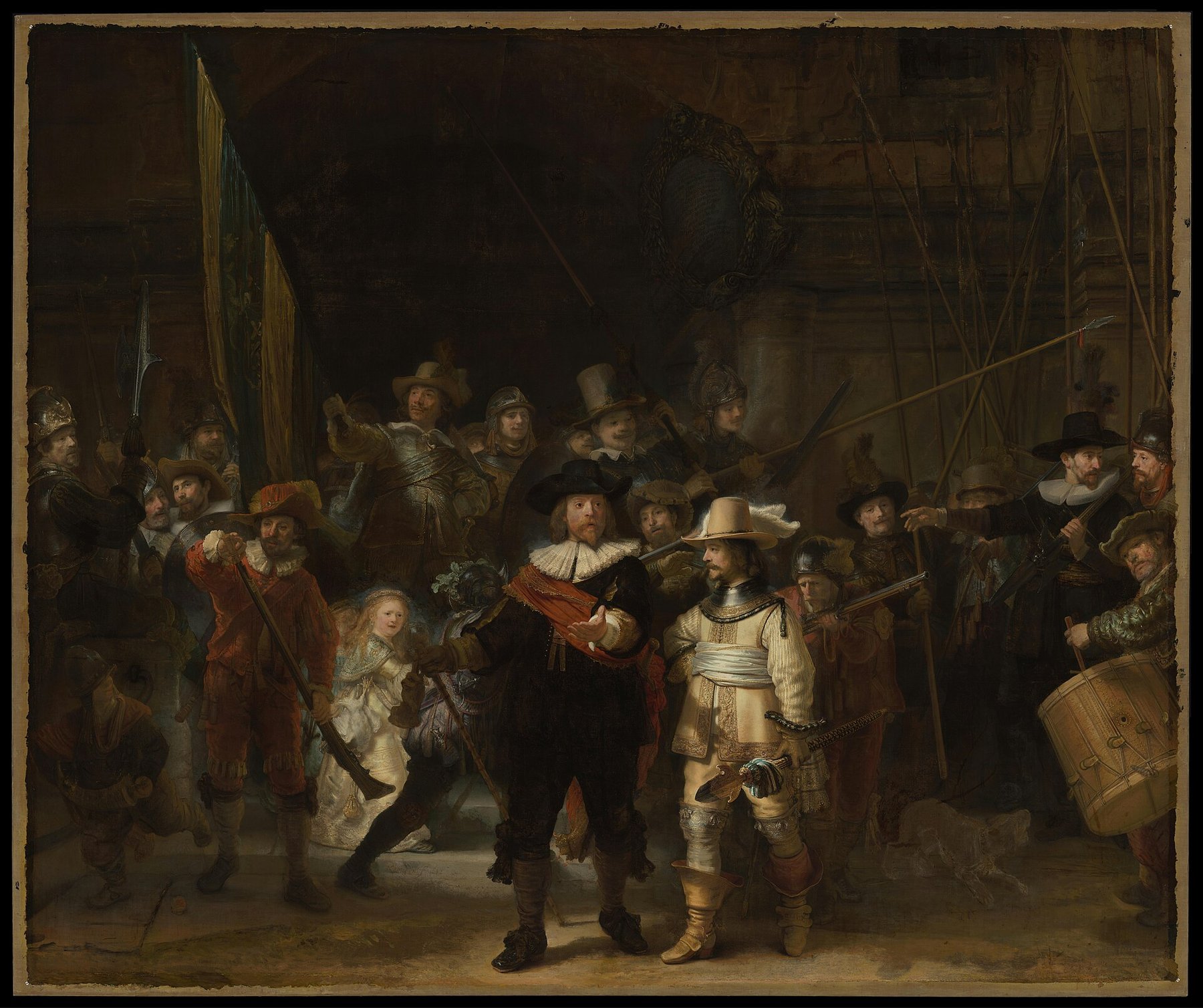
The Night Watch, painted in 1642, is Rembrandt's largest and most discussed picture: an oil on canvas of 363.8 × 437 cm in the Rijksmuseum, Amsterdam. It is a group portrait of an Amsterdam militia company under Captain Frans Banninck Cocq, with Lieutenant Willem van Ruytenburch beside him in yellow, and the company caught in motion rather than arranged at a table.
Two corrections to the popular picture matter at the start. First, the scene is daylight — the name took hold in the nineteenth century because darkened varnish made the painting look nocturnal, and cleaning revealed a daylit street. Second, the canvas we see is trimmed: in 1715 it was cut down to fit a wall in Amsterdam's town hall, and a copy made before then records what was lost.
What the painting is
The picture is a commissioned group portrait. Around thirty members of the company paid for their place, with amounts varying by rank; the two officers in front — the captain in black with a red sash and the lieutenant in yellow — were the core of the design. Around them Rembrandt filled the canvas with movement: a drummer, a dog, pikes and flags, and a small girl in a golden dress whose pouch carries a chicken, often read as a punning reference to the arquebusiers' emblem.
The composition differs from earlier Dutch militia portraits, which typically seated members in tidy rows around a banquet table. Here the company seems to be assembling or marching out; figures overlap, some are half-hidden, and the light is organised to carry the eye from the captain's outstretched hand to the lieutenant's costume and back through the crowd. It was radical enough that its reception has been debated ever since.
Amsterdam in 1642: the commission and its world
Rembrandt received the commission at the height of his Amsterdam career, shortly after moving into a large house by the Amstel and a year after the birth of his son Titus. Militia companies were civic institutions — part ceremonial guard, part social club for the city's prosperous citizens — and large group portraits of their officers were an established and lucrative genre.
The painting hung where such portraits did, in the company's meeting hall, the Kloveniersdoelen. It stayed in Amsterdam's public view continuously: in 1715 it was moved to the town hall on the Dam, cut down to fit the space between doors, and eventually transferred to the city's museum, which became the Rijksmuseum. Few Dutch paintings of the period have been in the public eye so long, and that visibility shapes how the picture has been argued over.
How the painting works
The engine of the picture is contrast within motion. Light falls selectively — the captain's hand, foreshortened and thrown towards the viewer, the lieutenant in lemon yellow, the girl's glowing dress — against a field of costumes in browns and muted tones. The red sash and the yellow uniform set the two officers apart, and diagonals of pike, banner and drum lead through the crowd in overlapping rhythms.
It is also a picture about a moment. Hands gesture, a musketeer loads his weapon, the dog barks at the drum — details that earlier group portraits would have suppressed in favour of equality and order. The lost left strip, which Gerrit Lundens's seventeenth-century copy preserves, contained a balustrade and part of at least one figure, and its removal tightened the composition in a way Rembrandt never intended.
The Rijksmuseum today, and what a replica can give
At the Rijksmuseum the painting closes the Gallery of Honour, and its scale is the point: over three and a half metres tall and nearly four and a half wide, with figures close to life size. Since 2019 the museum has run an ongoing technical research project on the canvas, Operation Night Watch, working in public view, which has added a great deal of documented detail about Rembrandt's materials and working habits.
A hand-painted replica faces a clear trade-off. The composition, the palette of blacks and golds, and the pattern of light can all be carried honestly into oil on canvas, and at full size the effect in a room is strong. What a replica cannot deliver is the density of the original — dozens of figures painted at life scale, plus the accumulated surface history of a 1642 canvas. It reproduces the image faithfully; the object belongs to Amsterdam.
If you want it on your wall
The Night Watch, hand-painted for your size
The same composition, painted in oil on cotton canvas by hand — from $189, in any proportional size, with six frame options and a numbered certificate of authenticity. It is a modern reproduction, not an antique, and the certificate says so; what it is not is a canvas print with a texture filter over it.
Free worldwide shipping, rolled in a rigid tube. Custom sizes and framing are quoted on the page.
Questions
Questions about The Night Watch
It was not painted that way. Layers of discoloured varnish darkened the picture over the centuries, and by the nineteenth century viewers assumed it depicted a night scene, which produced the name. Cleaning showed daylight: sunlight patches on the street, a bright sky, and warm light falling on the two officers. The painting remains tonally richer and darker than most seventeenth-century group portraits.
For practical, not artistic, reasons. In 1715 the canvas was moved to Amsterdam's town hall and trimmed so it would fit the wall space between two doors. The cuts removed a strip on the left side and smaller sections on the other sides, taking part of a balustrade and part of at least one figure. Gerrit Lundens's earlier small copy preserves the original composition and is itself in the National Gallery in London.
The central pair is documented: Captain Frans Banninck Cocq, in black with a red sash, and his lieutenant, Willem van Ruytenburch, in yellow, both named members of the company. The rest are militia members who contributed to the cost of the commission; not all can be securely named. The small girl in the golden dress has been linked to the company's emblem, but her identity is not established.
The canvas measures 363.8 × 437 cm, and the figures are close to life size. Even that is smaller than Rembrandt made it: the 1715 trimming removed portions on all sides, so the original was larger still. In the Rijksmuseum's Gallery of Honour the painting hangs alone at the end of the room, and its scale is the first thing most visitors comment on.
More masterpieces
Sandro Botticelli
The Birth of Venus
Botticelli's Birth of Venus is a tempera-on-canvas mythological scene from Florence, and some of its best-known stories — the patr
Vincent van Gogh
Sunflowers
The Arles Sunflowers in London was painted in August 1888 to decorate the room Van Gogh had prepared for Gauguin, and its famous y
Vincent van Gogh
Café Terrace at Night
In September 1888 Van Gogh painted the Place du Forum in Arles at night using blues, greens and yellows, and told his sister he ha
Want The Night Watch at your own size?
Tell us the wall and we will quote the canvas — hand-painted in oil, rolled and shipped free, with a numbered certificate.