Katsushika Hokusai · c.1830–1832
The Great Wave: a woodblock print that has been mistaken for a painting for a century
It is a colour woodblock print from Hokusai's Thirty-Six Views of Mount Fuji, made around 1830 to 1832, cut and printed by craftsmen rather than painted, and no two surviving impressions look quite alike.
Published 29 October 2026
| Artist | Katsushika Hokusai |
|---|---|
| Painted | c.1830–1832 |
| Medium | Colour woodblock print (ukiyo-e), from Thirty-Six Views of Mount Fuji |
| Size | About 25 × 37 cm (ōban) |
| Collection | Many collections, including the Metropolitan Museum of Art, New York |
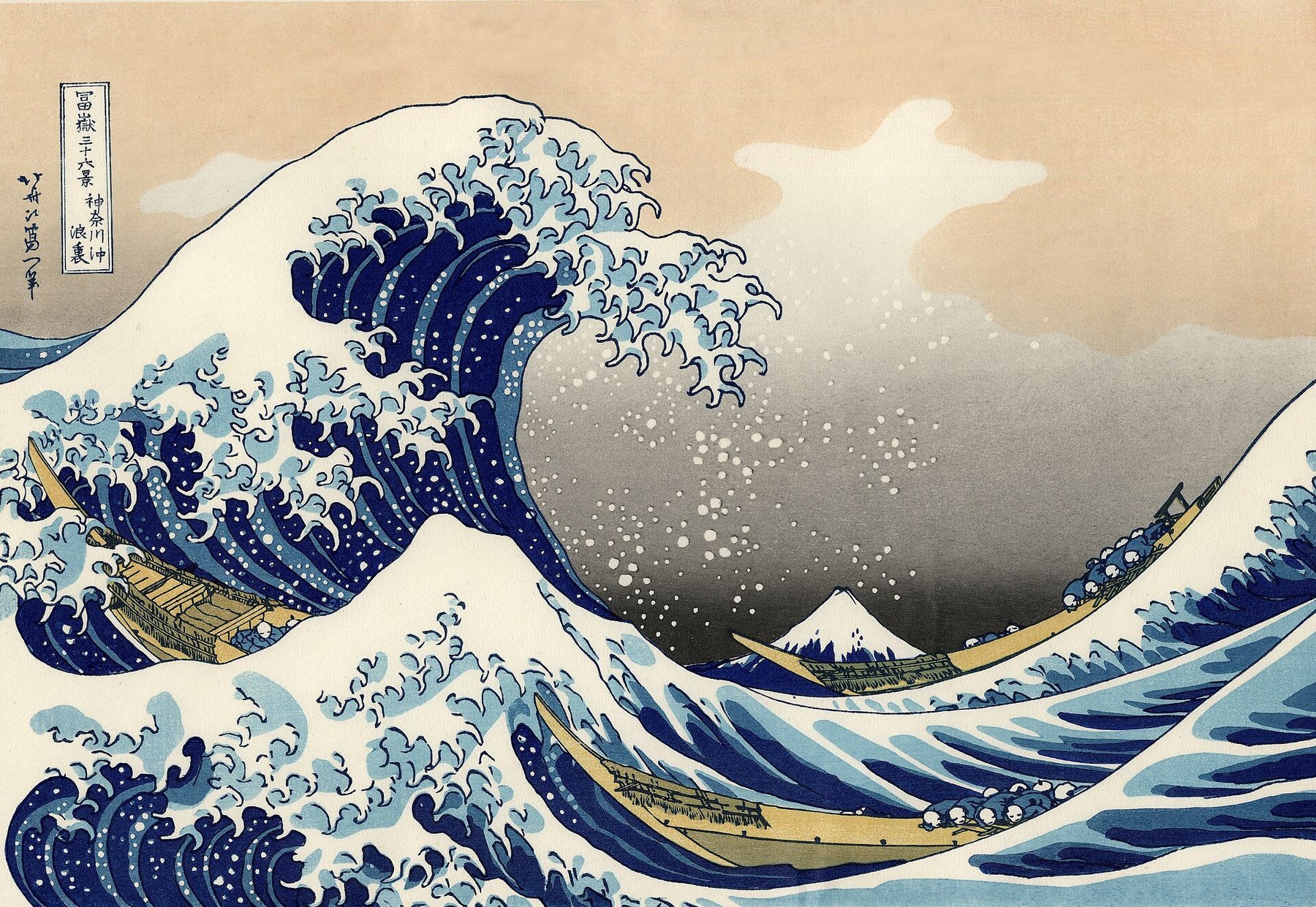
Not a painting. A colour woodblock print — ukiyo-e — from the series Thirty-Six Views of Mount Fuji, published around 1830 to 1832 by Nishimuraya Yohachi in Edo. The sheet is roughly 25 by 37 cm, printed from a set of cherry-wood blocks, one for each colour, on paper. The subject is a wave, three boats and a mountain; the mountain is the small triangle sitting in the hollow of the wave.
Because it is a print, there is no single original. Impressions are held by the Metropolitan Museum of Art, the British Museum, the Museum of Fine Arts in Boston and dozens of other collections, and they differ: in the depth of the blue, in the wear on the blocks, in the fading of the paper, in whether the key-block outline is crisp or soft. Any account of the colour of the wave is really an account of one impression.
What is happening in the picture
The wave is a breaking crest, its foam hanging over the boats in claws. Three oshiokuri-bune, the fast cargo boats of the Edo bay route, are running before it, packed with men reduced to dark shapes lying along the oars. Fuji sits in the trough between the swells, small, still, almost exactly on the vertical axis, and the wave's arc frames it rather than hides it.
The viewpoint is from the water and low, so the wave towers and the mountain shrinks. That inversion is the whole picture: the sacred mountain, the fixed point of the series, is made small by weather. The foam at the upper left breaks the edge of the sheet — an unusual decision, and the reason the image feels like a crop from something larger rather than a closed composition.
Hokusai at seventy
Hokusai was about seventy when the series appeared, and had been working for fifty years: book illustrations, surimono, actor prints, a long apprenticeship in commercial work for publishers. The Thirty-Six Views made his name and sold well enough that ten more views were added to the original thirty-six. It is late work by a man who had spent decades learning the trade he was now using for himself.
He signed himself the old man mad about drawing, and by his own account he expected to improve for another twenty years. That attitude is visible in the series: thirty-six views of one mountain, each with a different problem of scale, season or weather, the wave being the most extreme — the one where the subject of the series almost vanishes behind water.
Why it works
Two blues do most of the work. The deep blue of the water is Prussian blue, a pigment imported into Japan in the 1820s and suddenly available to print publishers; before it, blues in ukiyo-e were softer and more costly. The series used it hard, and the near-black of the wave is what makes the white foam read as sharp as it does against the pale sky. The same blue appears in the band of sky at the top, graded from dark to pale, which is a printer's effect as much as a designer's: the block is wiped by hand, so the density of that gradation shifts slightly from sheet to sheet and the sky is never twice the same.
The composition is a circle inside a triangle. The crest curls into a circle, Fuji is a triangle, and the boats lie on the diagonal between them. Hokusai had learned European perspective from imported prints, and the deep space here — receding sea, low horizon, a foreground that pushes forward — is not the flat space of earlier ukiyo-e. The wave's claw is also a formal rhyme with the mountain's snow, which is the joke under the drama.
Impressions, and copies of a copy
Impressions vary enormously. Early ones have a sharp key-block line and a graded sky; late ones, pulled from worn blocks, are softer, with broken outlines and paler colour. Some have been trimmed, some backed, some bleached by light. The Met's impression and the British Museum's are not the same object, which is why catalogues describe paper, seals and block condition rather than simply the image.
Which brings us to what we sell. A hand-painted oil version of the wave is a translation into another medium, and the things that make the print — the carved line, the flat ink, the registration of one block over another — cannot be painted, only imitated. What oil can do honestly is the drawing, the depth of the blue and the scale. We would rather say that plainly than pretend a painting is a print.
If you want it on your wall
The Great Wave off Kanagawa, hand-painted for your size
The same composition, painted in oil on cotton canvas by hand — from $189, in any proportional size, with six frame options and a numbered certificate of authenticity. It is a modern reproduction, not an antique, and the certificate says so; what it is not is a canvas print with a texture filter over it.
Free worldwide shipping, rolled in a rigid tube. Custom sizes and framing are quoted on the page.
Questions
Questions about The Great Wave off Kanagawa
No. It is a colour woodblock print from the series Thirty-Six Views of Mount Fuji, published around 1830 to 1832. The image was drawn by Hokusai, then cut into blocks by a carver and printed by a printer. Painted versions exist, but they are later copies of a print. It has been reproduced as a poster, a mural and an oil painting ever since, which is where most of the confusion comes from.
Nobody knows exactly. Several hundred impressions survive across museums and private collections, in widely different condition; the original blocks are not believed to survive. Because the blocks wore down with each printing, a late impression can look markedly softer than an early one. Estimates of the total vary, partly because the same sheet gets counted twice as it changes hands.
That is the point of the series. Fuji is the constant, and each view tests it against weather, distance or a foreground that overwhelms it. Here the wave takes the frame and the mountain sits in the trough, framed by the crest — a reversal that made the print famous and still surprises people who expect a landscape.
The Metropolitan Museum of Art in New York, the British Museum in London and the Museum of Fine Arts in Boston all hold impressions, though prints on paper are rotated for exposure to light, so they are not always on view. Check before travelling; the impression on display may not be the one in the book.
More masterpieces
Claude Monet
Water Lilies (Nymphéas)
Monet painted the water garden at Giverny from 1899 until his death in 1926 — around 250 canvases of the same surface of water, en
Vincent van Gogh
The Starry Night
Van Gogh painted this in the summer of 1889 from a room in the asylum at Saint-Rémy, and the village underneath the sky is not the
Gustav Klimt
The Kiss (Der Kuss)
Klimt finished it in 1908, the Austrian state bought it the same year, and it has hung in Vienna ever since — 180 cm square, oil a
Want The Great Wave off Kanagawa at your own size?
Tell us the wall and we will quote the canvas — hand-painted in oil, rolled and shipped free, with a numbered certificate.